You launch a push campaign in a solid Tier 2 GEO at $0.03 a click. Everything works, ROI looks green, life is good. Then day four hits, traffic drops off a cliff, and the only way to get impressions back is bumping your bid to $0.05. Suddenly your margin goes up in flames.
Sounds familiar? It happens every day in affiliate marketing. Bids in ad networks aren't static. They jump around based on who's pouring budget into the auction, creative fatigue, seasonal caps, and network algorithms.
If you treat CPCs like magic numbers set by the network, you'll burn through test budgets fast. Here is how network auctions price your clicks behind the scenes and how to keep your average CPC low without killing your volume
🚀 Register with the MyBid ad network right now to get instant access to 6 high-converting ad formats (Popunder, Push, In-Page Push, Telegram Mini Ads, Banner, Video), massive global traffic volumes across all Worldwide GEOs, lightning-fast campaign moderation, dedicated account manager support, and exclusive perks to maximize your ROI — join MyBid today and scale your campaigns!
How RTB Auctions Work (And Why High Bids Lose)
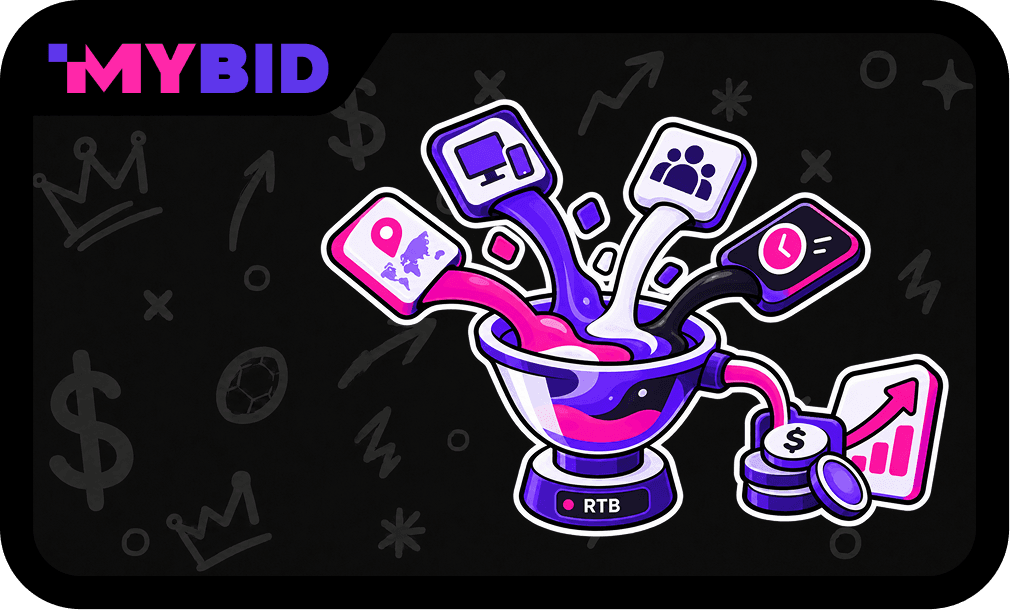
Ad networks don't sell traffic at fixed rates. Every click or view is bought in real-time through an RTB auction that finishes in milliseconds.
Most networks run a second-price auction. Set your max bid to $0.10, and if the second-place buyer sits at $0.06, you only pay $0.061. That keeps you from overpaying if there's a big gap between you and the rest of the market.
Still, throwing money at the auction won't guarantee top volume. Networks care about yield per thousand impressions, so they rank ads by eCPM (eCPM = CPC x CTR x 1000)—how much revenue your creative generates per thousand views.
If your creative hits a 2% CTR on a $0.05 bid, your eCPM is $1.00. A competitor might bid $0.15, but if their creative is dead at 0.3% CTR, their eCPM is only $0.45. The network makes way more money showing your ad, giving you top placements for a third of your rival's click price.
What Sets Your Baseline Traffic Cost
1. GEO Tiers and Market Value
Geography sets your base price:
- Tier 1 (US, UK, DE, JP, AU): High offer payouts ($50 to $200+) mean big teams dump huge budgets into the auction. Competition is brutal, pushing classic push CPCs from $0.07 to well over $0.35.
- Tier 2 (BR, PL, VN, TR, MX): The sweet spot for scaling. Huge volumes of active users, solid conversion rates, and decent payouts. CPCs sit comfortably between $0.015 and $0.06.
- Tier 3 (NG, PK, BD, ID, PH): Mass traffic, small payouts, and low competition. Clicks cost under two cents, making Tier 3 great for broad sweeps, app installs, or utility offers.
2. Verticals and CPA Payout Ceilings
Your offer payout caps your max bid before your ROI goes red:
- Crypto, Gambling, & Finance: Offers paying $100–$600+ per FTD give buyers room to bid aggressive. Expect CPCs from $0.08 to $0.40+ as teams push to corner high-LTV traffic.
- Dating (Mainstream & Adult): Registrations pay $1.50–$6.00. Conversion rates are predictable, holding CPCs between $0.025 and $0.09.
- Utilities, VPNs, & Sweeps: Low-friction offers like app installs or email submits pay modest amounts ($0.50–$2.00). You win on raw volume with cheap $0.005–$0.03 clicks.
3. Seasonality and Time-of-Day Spikes
Auctions swing on a clear calendar:
- The Q4 Rush (Oct – Dec): E-com brands and big agencies flood networks with holiday cash for Black Friday and Christmas. CPMs and CPCs jump 20% to 40% across all formats.
- The Q1 Reset (Jan – Feb): Corporate budgets dry up post-holidays. Competition cools off and CPCs drop 15% to 30%. It's the best window to test new landers and scale on cheap traffic.
- Peak Hours: In gambling, sports betting, and adult dating, user activity spikes during evenings and weekends. Auctions heat up fast during these peak engagement windows.
4. Overheated Placements and Competitor Waves
When a media buying team enters your GEO with a massive daily cap, they push up floor prices on top publisher feeds.
Don't try to outbid them head-on. Try this instead:
- Dayparting: Pause campaigns when big teams burn their daily caps, then turn them back on when their budgets run dry.
- Micro-bidding: Cut bids on weak SubIDs, older OS versions, or specific browsers instead of blacklisting the whole feed.
- GEO Shift: Take your winning angle and lander to a neighboring GEO in the same tier where bidding pressure is lower.
Format choice controls your contact cost and how well you beat banner blindness:
- Classic Push: System alert sent straight to the user's device. High trust and solid CR at $0.01–$0.15 CPC.
- In-Page Push (IPP): Floating banner on the publisher site. IPP bypasses browser rules, hitting iOS and macOS users for $0.005–$0.08 CPC.
- Popunder: Loads your lander in a background tab. Sold on CPM ($0.20–$3.00), pop gives you tons of volume on a tight budget.
How to Cut Your Average CPC
- Rotate Creatives Often: Creative fatigue kills CTR. When CTR drops, your eCPM tanks, forcing you to raise bids just to get impressions.
- Split Desktop and Mobile: Desktop traffic is usually more expensive. Mixing them in one campaign lets pricey desktop clicks swallow the budget you should be using for converting mobile users.
- Prune SubID Bids Weekly: Stop paying flat rates across whole publisher feeds. Cut bids on sources with poor conversion rates and shift that saved cash into your top SubIDs.
FAQ
Why does my average CPC jump when I try to scale?
To deliver higher daily volume, the network pushes your campaign into tougher auctions against bigger spenders. At the same time, ad frequency causes creative fatigue. As your CTR drops, the system charges higher CPCs to maintain your impression share.
How does a better CTR lower my traffic costs?
Networks make money on overall click yield per thousand views. If your creative gets 20 clicks per 1,000 views and a competitor gets 3, the network makes way more money showing your ad. The algorithm rewards that revenue with top ad spots at a discounted CPC.
Why is Q4 traffic so expensive?
E-com brands and major advertisers dump huge budgets into networks before the holidays. Their high CPM bids raise floor prices across all publisher feeds.
Click prices move constantly, but you don't have to overpay. Keep your CTR high, adjust bids at the SubID level, and take advantage of auction drops to cut your CPC by 30% to 50% without losing conversions.