The MyBid blog is your expert guide to conversion traffic.
We share real-world case studies, insider tips, and practical guides for our
ad network. Learn how to master these tough verticals and run profitable
campaigns with our tools. No theory, just actionable advice to boost your profit.
[ Geotargeting basics: How to actually reach the right people in 2026 ]
08.06.2026Affiliate Marketing How to start?12 min
Contents
So, picture an affiliate setting up a new casino offer. They use the same creatives and bids but target the entire world at once. In the US, they end up paying $2 for clicks that don't convert.
Over in Indonesia, a click is just $0.02, which looks great until they realize the deposits are tiny. Brazil ends up being a confusing middle ground. Without proper Geotargeting, you can't see the reality of your stats. You're just burning cash because everything is lumped together in one big mess.
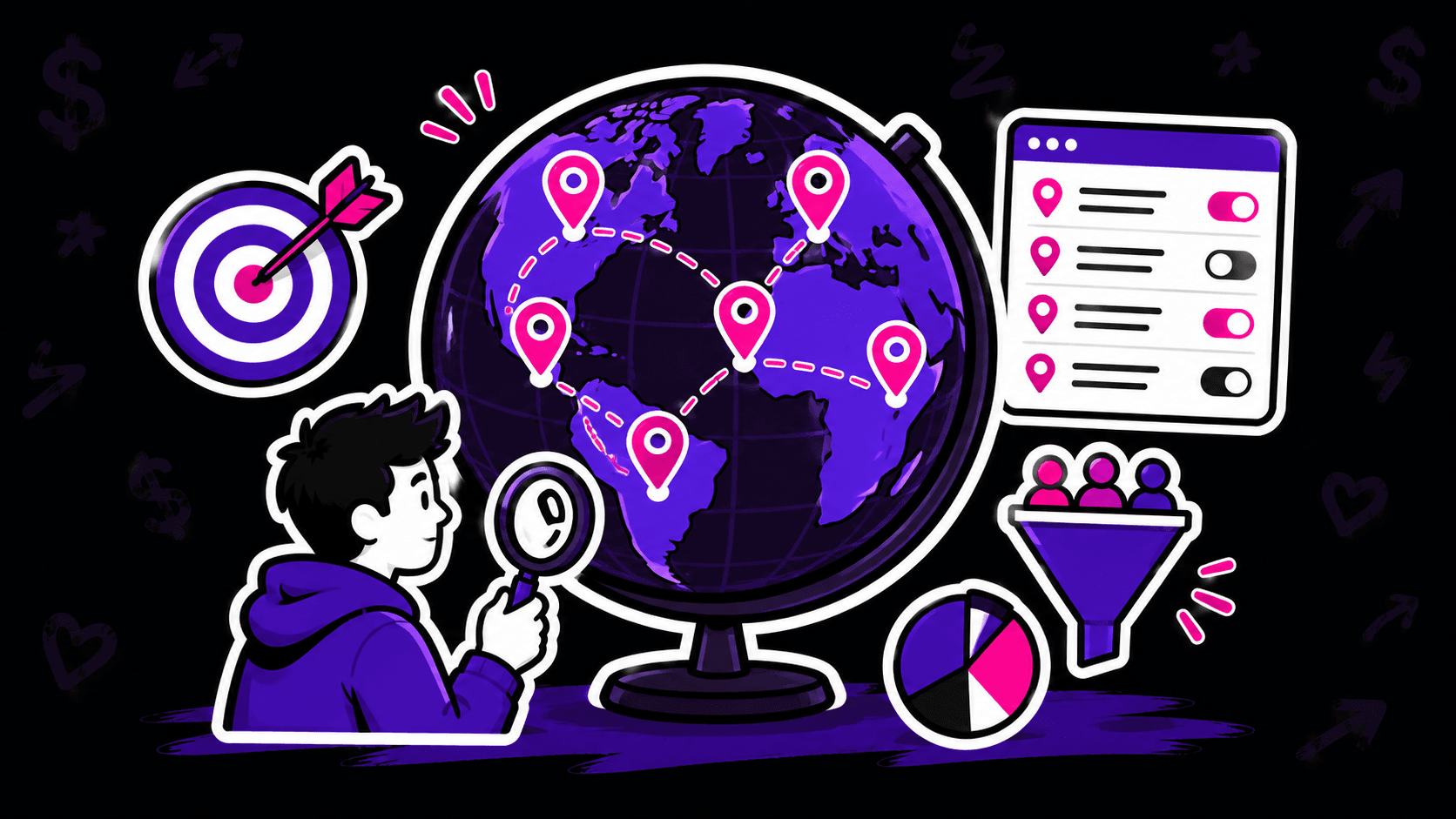
Geotargeting basically ensures your ads only pop up for people in very specific spots—like a country, a city, or even a tiny radius around a shop. It relies on things like IP addresses, GPS, and Wi-Fi signals. By 2026, trying to run a serious campaign without this is pretty much impossible.
We're going to go over how the tech works and why Geotargeting is different from Geofencing or Geoframing. I've also included the latest GEO tier tables, a breakdown of which verticals work best where, and a simple setup guide.
What Is Geotargeting?
At its simplest, Geotargeting means your ad only shows up for people in specific locations. You might want to hit an entire country, or maybe just a 500-meter circle around a physical store. If someone is standing outside that line, they simply won't see your ad.
It works on a few different levels. IP addresses are the most common but usually only get you as close as the city. Mobile apps use GPS, which is much more precise—think meters rather than miles. Even if you don't ask, things like Wi-Fi and cell tower data help platforms figure out where a device is located.
In the world of affiliate marketing, we use this all the time. You wouldn't want to show dating ads in Saudi Arabia or promote gambling where it's illegal. If you aren't filtering by geography, you're just wasting your budget.
Start your campaigns the smart way — join MyBid today. Access premium traffic, real optimization tools, and expert managers who guide you from the first test to a profitable setup. Make your launch safe, structured, and data‑driven — sign up to MyBid and scale with confidence.
How Geotargeting Works
Technically, here's what happens. When you open a website, the ad platform picks up signals about where you are. The IP address is the big one—it tells the server which country and city the request is coming from. These databases get updated often, though sometimes an ISP might accidentally list a user in a completely different city.
GPS is the gold standard for accuracy, but it needs the user's okay. Maps or food apps usually have this permission, and ad networks can tap into that data if their tech is built into the app.
Then you have Wi-Fi and cell towers. They aren't quite as sharp as GPS, but they work without needing explicit permission. Google, for instance, gathers this through Android location services.
Sometimes it's even simpler—like when a user just types their city into a profile. It's not real-time tracking, but it gets the job done for certain types of targeting.
As a media buyer, you don't really need to stress about the backend. Most ad platforms and DSPs do the heavy lifting. You just pick the countries you want in the settings and let the system handle the rest.
Geotargeting vs Geofencing vs Geoframing
These terms get mixed up constantly, even by people who have been in marketing for years. While they sound alike, they definitely aren't the same thing.
Geotargeting is the broad stuff: countries, states, and cities. This is what most affiliate marketers use day-to-day.
Geofencing is about virtual boundaries. You map out a specific zone, like a stadium or a mall, and trigger ads when someone enters or leaves that space. It's great for local shops or cafes, but you rarely see it in CPA marketing.
Geoframing takes it a step further by tracking where someone has been. It might see someone went to the airport and then a specific hotel, then show them ads based on that journey. It requires massive amounts of data, so it's not really a thing in the affiliate world yet.
Comparison table
Parameter
Geotargeting
Geofencing
Geoframing
Core idea
Show ads by country/city
Create virtual zone on map
Track movement between zones
Accuracy
Down to city/region
Down to meters
Down to movement path
For 99% of tasks in affiliate marketing, simple geotargeting by country is enough. The rest is for offline and enterprise.
GEO Tiers Explained: Tier 1, Tier 2, Tier 3
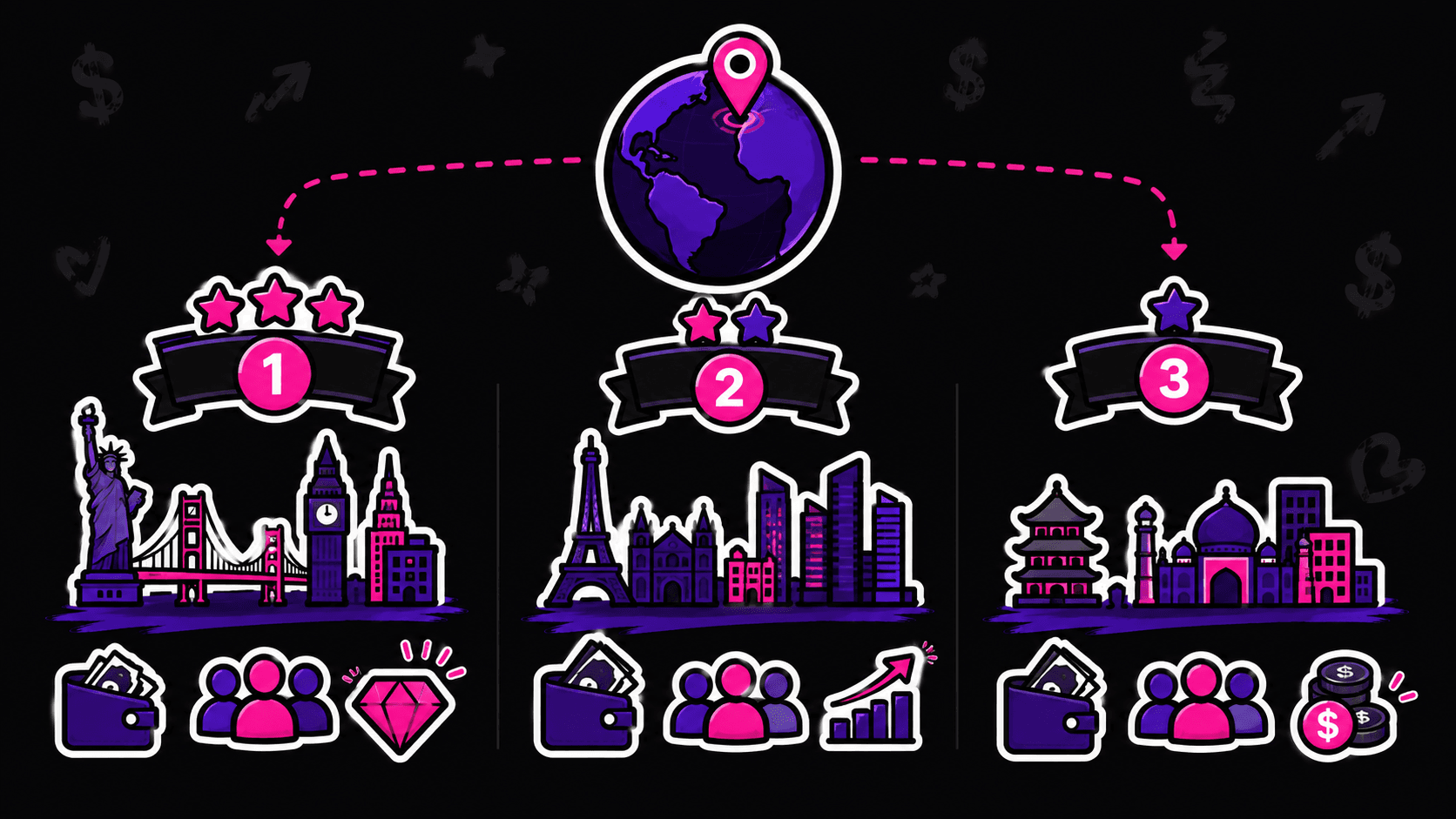
In affiliate marketing, countries are grouped into three categories – tiers. This is an unofficial but widely accepted classification. It helps understand traffic costs, offer payouts, and what to expect from the audience.
Tier 1 – wealthy countries with high incomes. USA, Canada, Australia, almost all of Western Europe. Expensive traffic, high payouts, fierce competition. The audience is ad-spoiled, hard to impress. But one quality lead can bring tens or hundreds of dollars.
Tier 2 – countries with above-average or average income. Eastern Europe, Latin America, parts of Asia (Japan, South Korea, Malaysia), the Middle East (UAE, Turkey). Cheaper traffic, lower payouts, less competition. The audience is more responsive, more trusting of ads. A good balance for starting out.
Tier 3 – developing countries with low incomes. Indonesia, India, Philippines, Bangladesh, most of Africa, some former Soviet republics. Very cheap traffic. Small payouts, but on large volumes you can earn well. The audience is less sophisticated, registration conversions are high. Perfect for testing.
Tier 4 also exists, but in practice it’s ignored. Countries without access to payment systems, with total ad blocking, or outright poor. Syria, Afghanistan, North Korea. Nothing to do there.
Table: GEO tiers
Tier
Countries
Avg CPM (USD)
Best verticals
Notes
Tier 1
USA, Canada, UK, Germany, France, Australia, Norway, Sweden, Switzerland
$10–30
Finance, crypto, software, premium gambling
High competition, solvent audience, strict rules
Tier 2
Poland, Czechia, Brazil, Argentina, Turkey, UAE, Malaysia, Japan, South Korea
$3–10
Dating, nutra, gambling, e‑commerce
Middle income, good price/conversion ratio
Tier 3
Indonesia, India, Philippines, Vietnam, Bangladesh, Pakistan, Nigeria, Kenya
$0.5–3
Mobile apps, subscriptions, push‑subscriptions
Cheap traffic, large volumes, low purchasing power
Numbers are approximate. Everything depends on traffic source, ad format, season. Prices rise in December, drop in January.
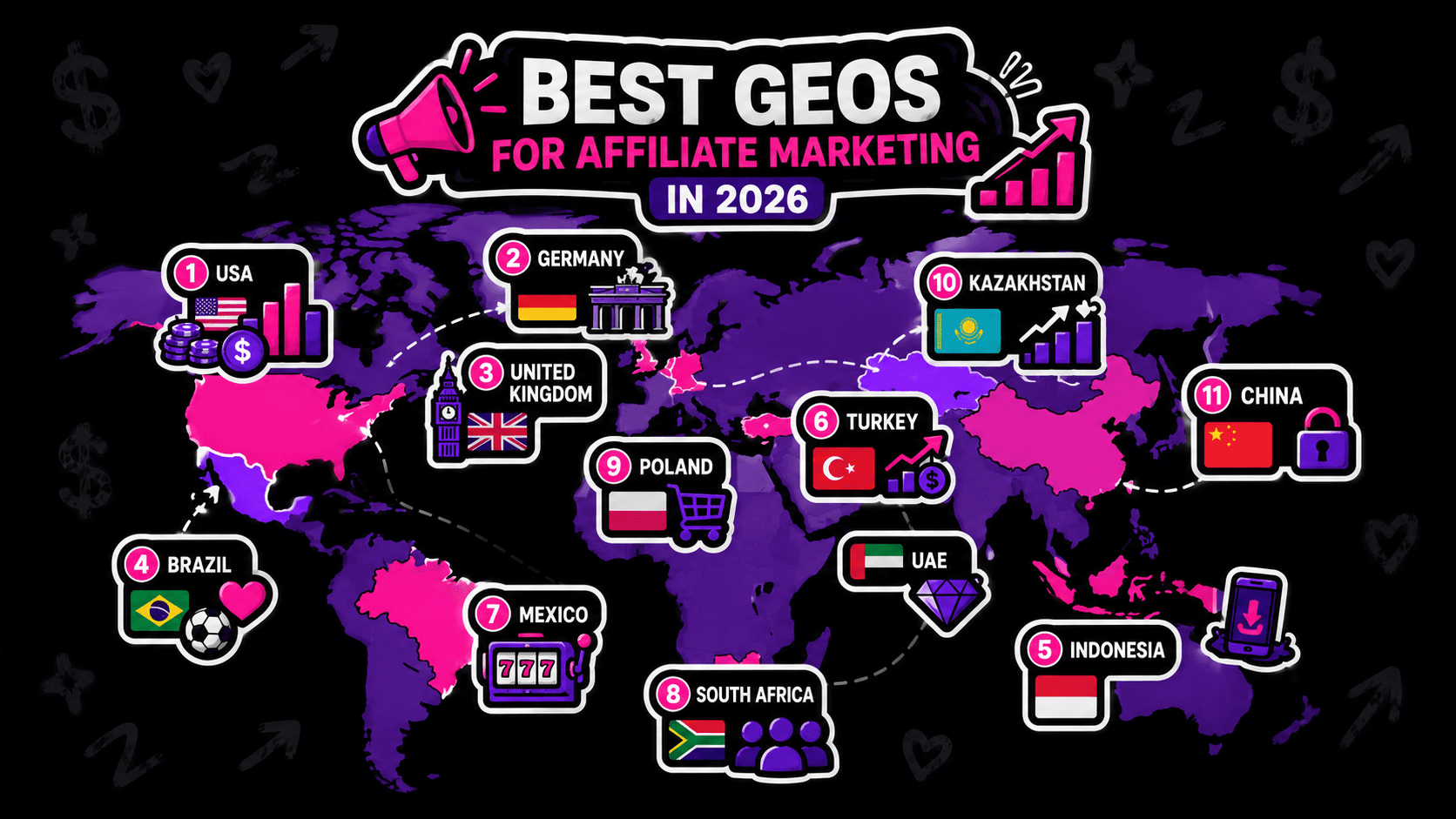
Best GEOs for Affiliate Marketing in 2026
The data comes from published affiliate case studies and ad network reports. Figures are current as of early 2026.
USA — the leader in traffic volume and payouts. Gambling, finance, crypto, software — all perform great, but ads are expensive and competition is brutal.
Germany — a European Tier 1 with high CPM and stable conversion. Clean landers and honest offers perform best.
United Kingdom — similar to the US but with stricter rules. Active, wealthy audience.
Brazil — the main Tier 2 for gambling and dating. Cheap, mobile‑heavy, massive volumes.
Indonesia — ultra‑cheap Tier 3 traffic with huge scale. Perfect for push, mobile apps, low‑ticket ecom.
Turkey — a growing market with strong crypto, dating and cautious gambling performance.
Mexico — US‑like behavior with Tier 2 pricing. Gambling, dating, nutra — all fly.
South Africa — the only African market with consistently strong conversions.
Poland — one of the most predictable Eastern European markets. Users respond well to ecom, dating, webcams. Traffic is cheaper than Western Europe but still high‑quality.
Kazakhstan — a strong CIS market with active mobile traffic. VPN, nutra and finance perform especially well. Users convert quickly on simple, straightforward offers.
China — a massive but heavily restricted market with huge potential. With proper adaptation, traffic scales impressively. Adult, viral content and news formats work, but require careful tuning and testing.
How to Use Geotargeting in Ad Campaigns (Step by Step)
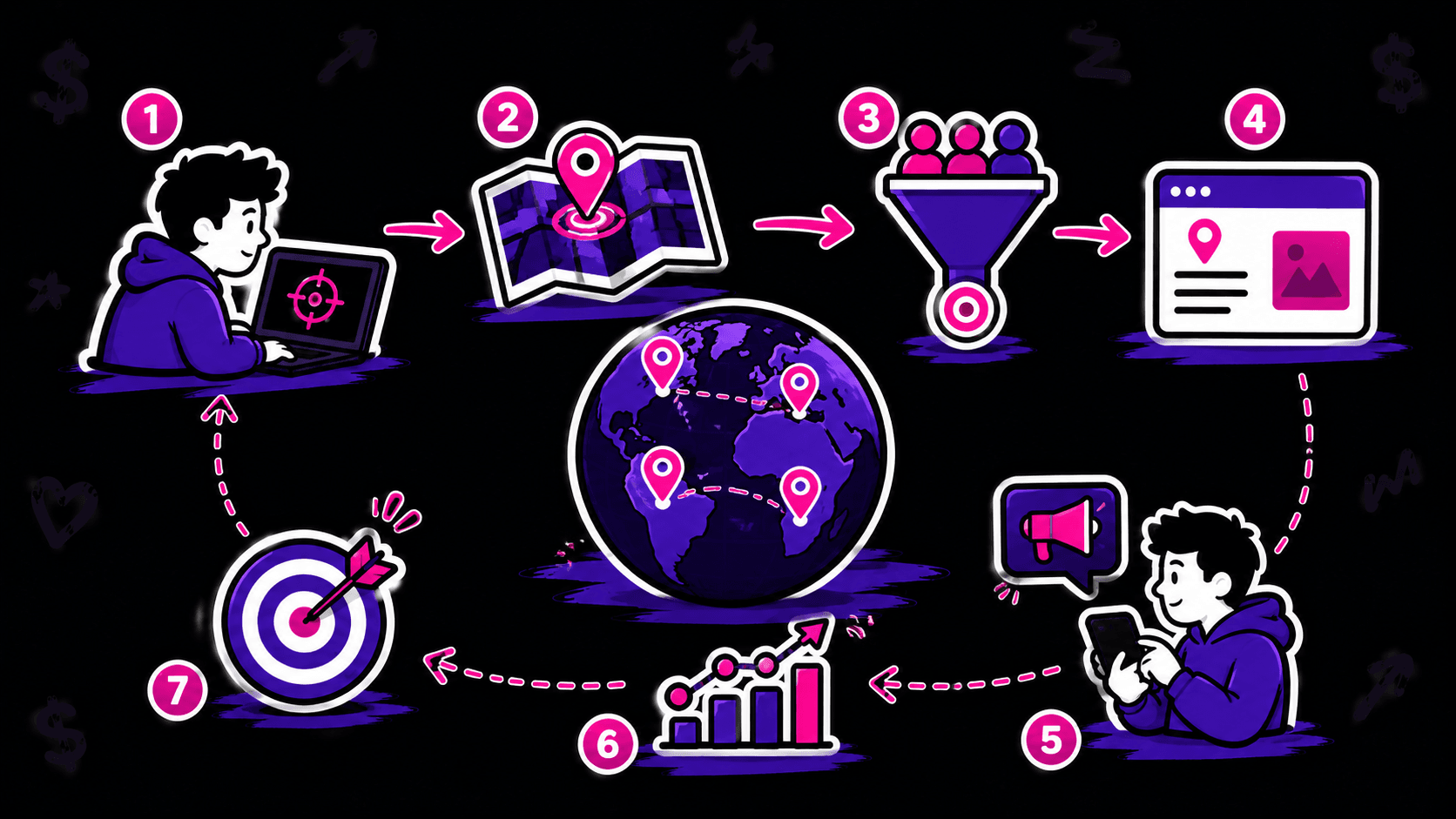
Setting up geotargeting in most DSPs and ad networks is standard. Let’s use any platform with geo‑filters as an example.
Step 1. Choose the geo type – countries, regions, cities, or zones. In affiliate marketing, country‑level targeting is most common. Sometimes state‑level in the US or provinces in Canada, because gambling and betting laws vary.
Step 2. Specify a concrete list – add the countries you want. You can exclude unwanted ones – for example, block ads everywhere except the US. Or the opposite, allow only five countries.
Step 3. Set include or exclude – two approaches. Whitelist: show ads only in selected countries. Blacklist: show everywhere except selected. Whitelist is more economical and precise.
Step 4. Account for languages and cultural differences – selecting a country is not enough. You need to adapt creatives. In Canada, part of the audience speaks French. In Belgium – Flemish and French. In Switzerland – German, French, Italian. Language mistakes kill conversion.
Step 5. Launch and check geo breakdown – after launch, review reports by geo. Sometimes one city brings 80% of conversions while the rest of the country gives zero. Then narrow targeting to specific regions.
Geotargeting Strategies by Vertical
Not all verticals perform the same on the same tiers. You need to match each vertical.
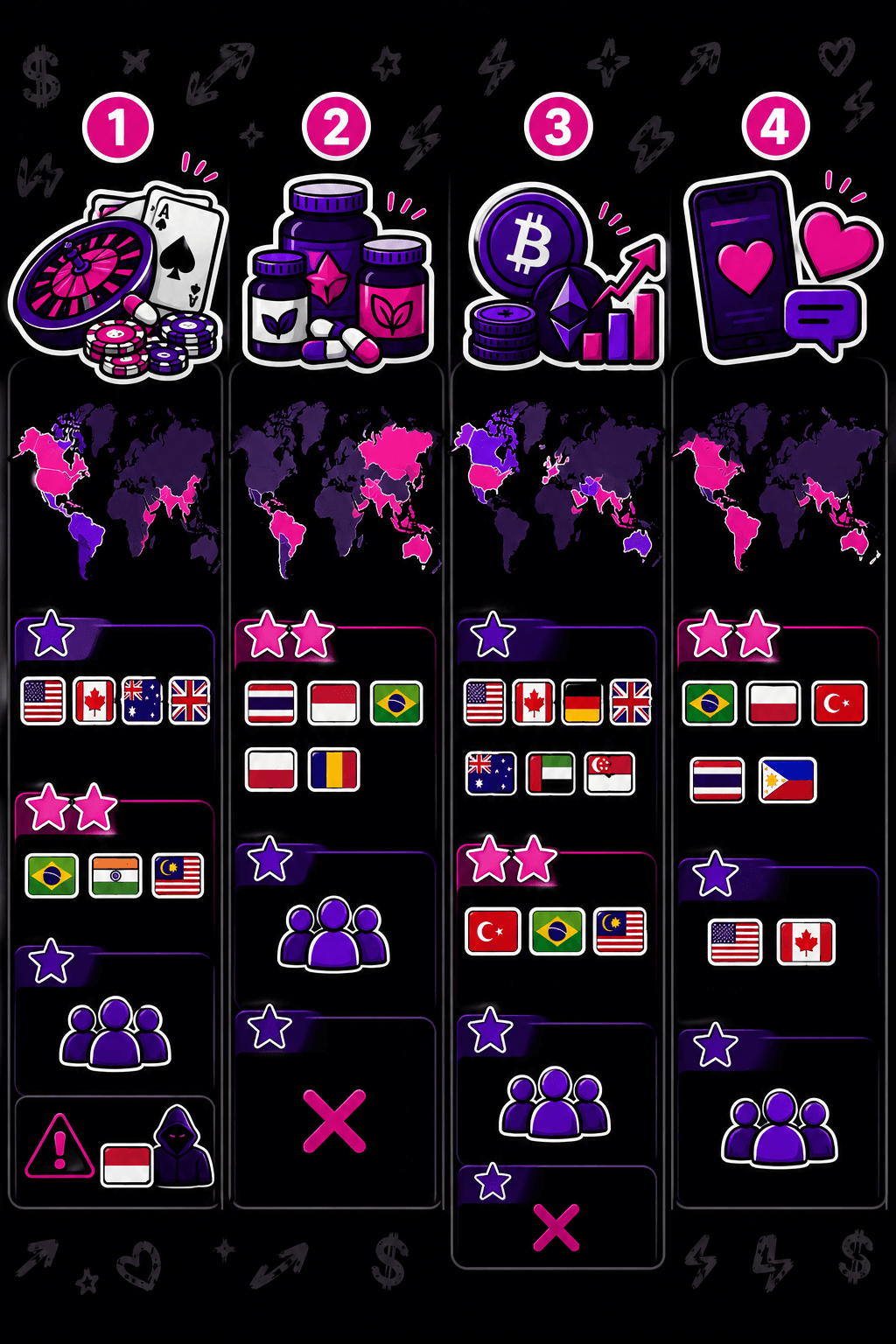
Gambling and Betting
The most profitable GEOs are Tier 1 (USA, Canada, Australia, UK) and some Tier 2 (Brazil, India, Malaysia). In Tier 1, people play for entertainment, LTV is high. In Tier 2 – as a way to earn, lower purchasing power but cheap traffic. In Tier 3, gambling barely works due to low income and blocks. Exception – Indonesia, where gambling is banned but some run it via proxies and cloaking. High‑risk.
Nutra
Almost always Tier 2 and Tier 3. Because in wealthy countries fewer people believe in miracle products. Asia, Latin America, Eastern Europe – ideal. Thailand, Indonesia, Brazil, Poland, Romania. Cheap traffic, high conversions, low returns. In Tier 1, nutra barely works – strict laws, ads get blocked, audience is suspicious.
Crypto
Here it’s the opposite. Need wealthy countries with developed financial markets. USA, Canada, Germany, UK, Australia, UAE, Singapore. People understand crypto, ready to invest serious money. Expensive traffic, but profit matches. Tier 2 also works (Turkey, Brazil, Malaysia), but LTV is lower. Tier 3 is useless for crypto – people won’t risk their last money.
Dating
Sweet spot – Tier 2. Brazil, Poland, Turkey, Thailand, Philippines. Cheap traffic, high conversions, people are active. Tier 1 also works (USA, Canada), but ads are expensive, and payback is worse unless precisely targeted. Tier 3 – only for no‑strings dating and quick registrations.
Table: strategies by vertical
Vertical
Best tiers
Example countries
Why
Gambling & Betting
Tier 1, partly Tier 2
USA, Canada, Brazil, India
High LTV or cheap traffic
Nutra
Tier 2, Tier 3
Thailand, Brazil, Poland, Indonesia
Trusting audience, low competition
Crypto
Tier 1, upper Tier 2
USA, Germany, UAE, Turkey
Solvent, interested audience
Dating
Tier 2
Brazil, Poland, Turkey, Philippines
Balance of price and conversion
E‑commerce
Tier 2–3
Malaysia, Indonesia, South Africa
Large volumes, low CPC
Subscriptions & Software
Tier 1, Tier 2
USA, Canada, Germany, Australia
Willingness to pay for services
Common Geotargeting Mistakes
Everyone makes mistakes. Here are the most common pitfalls.
Targeting the whole world. Budget burn guaranteed. Never launch campaigns without geo‑filtering. Even if you think the product is universal.
Ignoring cultural differences. The same creative may work in Brazil but fail in Germany. Because humour, colours, calls‑to‑action are perceived differently. Test separately for each country.
Forgetting about multiple languages within one country. Canada, Belgium, Switzerland – each has several languages. Showing a German ad in French‑speaking Switzerland kills conversion.
Not checking local laws. Gambling is banned in Indonesia. Dating is banned in some Arab countries. Crypto is banned in China. Account ban and lost budget guaranteed.
Same bids for all GEOs. You cannot pay the same CPC in the US and Indonesia. In the US the bid must be higher, in Indonesia lower. Otherwise you either miss traffic or overpay.
Not testing specific regions inside a country. Sometimes one state or province gives 80% of conversions, and the rest zero. Without granularity, you won’t see this.
Ignoring time zones. Ads run 24/7, but your audience sleeps. If you target Brazil from Europe, peak activity may be 2–3 AM your time. You can miss conversion windows.
FAQ
What is geotargeting in digital marketing in simple words?
It’s when ads are shown only to people from selected countries, cities, or areas. Everyone else does not see them.
What is the difference between geotargeting and geofencing?
Geotargeting works at country/city level. Geofencing draws zones on a map and catches users inside with meter accuracy.
Which countries are Tier 1?
USA, Canada, UK, Germany, France, Australia, Norway, Sweden, Switzerland, Netherlands, Denmark, Finland. Wealthy countries with expensive traffic.
Where should a beginner start: Tier 1, Tier 2 or Tier 3?
Better to start with Tier 2. Traffic is not too expensive, competition moderate, mistakes won’t ruin you. Tier 1 requires large investment. On Tier 3, without big volumes you won’t get high income.
How to know which GEO fits my offer?
Check recommended countries in your affiliate network. Read case studies from other affiliates. Test 2–3 countries from different tiers with small budgets and see where ROI is best.
Can I set geotargeting at city level?
Yes, many DSPs and ad networks support this. Especially useful for e‑commerce with delivery or offline services. In traffic arbitrage it’s used less often, but works for some tasks.
Do GEO tiers change over time?
Yes, tiers are not official but practical. Countries move from Tier 3 to Tier 2 and back. For example, Vietnam was Tier 3 five years ago; now it’s often considered lower Tier 2.
Outro
Geotargeting is not just a checkbox in settings. It’s the foundation of any decent campaign. Without it you’re flying blind. With it you see where profit is and where loss is.
Understanding GEO tiers helps you pick countries for each vertical. Tier 1 gives high ticket value but requires money. Tier 2 is the sweet spot. Tier 3 gives volume and cheap testing.
MyBid gives access to over 200 GEO. Launch anywhere, no middlemen. Set up geotargeting in a couple of clicks, view analytics per location, and scale what actually works.
Sign up for MyBid. Choose an offer. Set up Geotargeting. And take profit from where your ads are truly needed. Don’t burn your budget on the whole world – show your ads only to those ready to buy.