The MyBid blog is your expert guide to conversion traffic.
We share real-world case studies, insider tips, and practical guides for our
ad network. Learn how to master these tough verticals and run profitable
campaigns with our tools. No theory, just actionable advice to boost your profit.
[ What Is Media Buying? A Beginner's Guide to Ad Space ]
29.05.2026Affiliate Marketing How to start?15 min
Contents
Imagine you launch ads on social media. You spend $500, but get only $100 in sales.
In 2026, major brands pour dizzying amounts into digital advertising – hundreds of thousands of dollars per day. And yet they manage to earn three to four dollars back for every dollar spent. No magic, no secret “insider” rooms. It’s much simpler – they know how to buy ads properly.
Media buying is about how you purchase impressions and ad space. From a banner on a news site to a pre-roll video on YouTube. The goal is always the same: get your message in front of the right people, at the right moment, at a price that doesn’t make your marketer’s heart stop. Don’t overpay, but don’t lose to competitors.
If you’re just getting into affiliate marketing or want to run ads without pointless budget waste, understanding what is media buying is essential. It’s the foundation, the bedrock, the starting point. In this guide we’ll break everything down clearly: no jargon, no fluff. With examples, tables, and real numbers – so the picture comes together immediately.
What Is Media Buying?
Media buying sounds complicated. In reality, it’s just renting. You rent space on a website, in an app, on social media, or even on the radio. You pay for your ad to be seen or heard. The process includes finding that space, negotiating the price, launching the ad, and constantly improving its performance.
In media buying, there are always at least two sides. The publisher owns the platform. They sell ad space. The media buyer purchases that space – for themselves or for a client. Sometimes an agency sits in between, helping secure discounts and better terms.
The media buyer’s job sounds simple but is hard in practice: make the ad budget deliver maximum results. It’s not “set $50 and forget it.” It’s constant analysis, bidding, testing images and headlines, cutting garbage channels, and scaling what actually works.
Media Buying vs Media Planning: Key Differences
These two terms are constantly confused. Even experienced marketers sometimes use them interchangeably. But the difference is real and important.
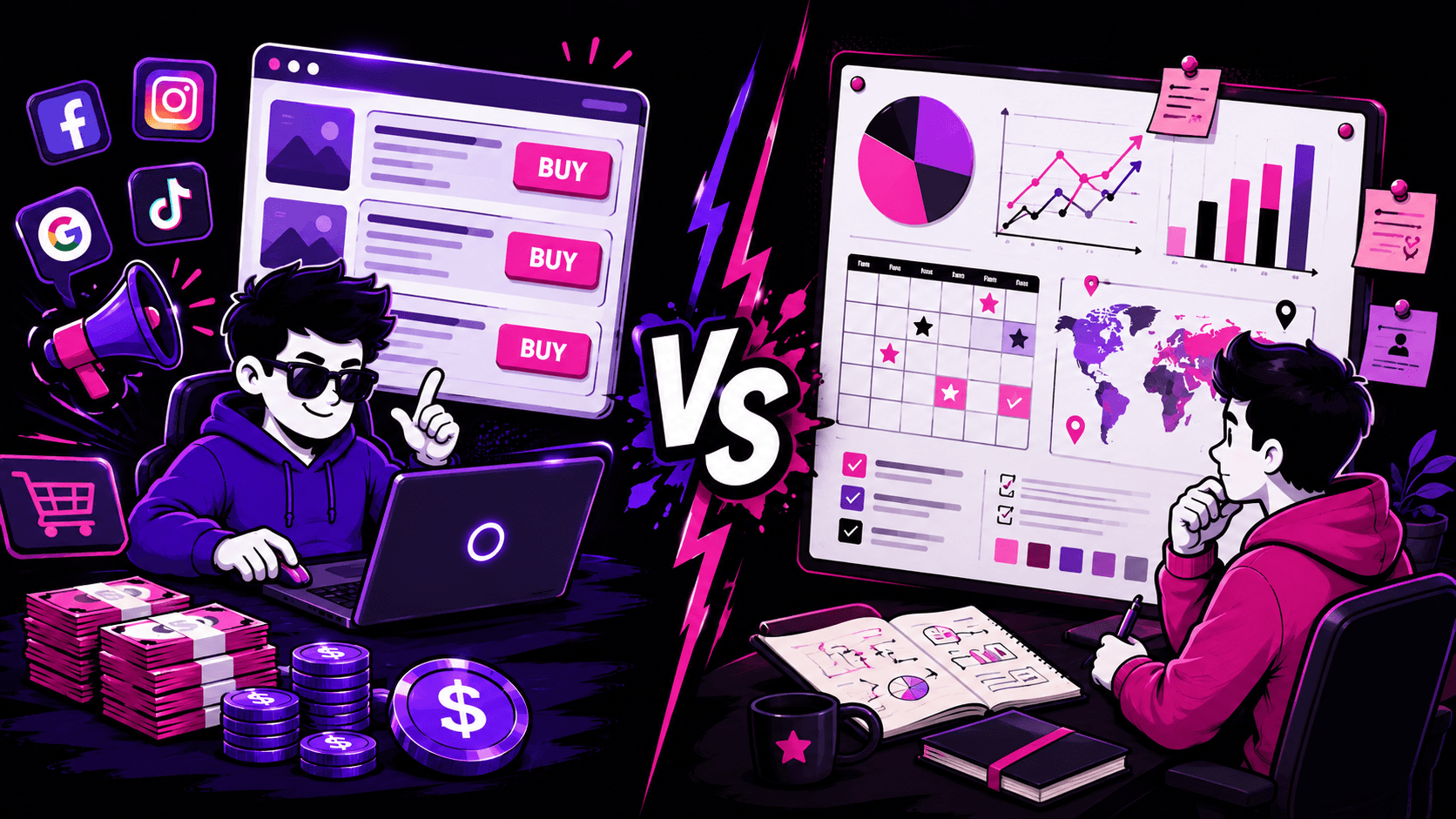
Media planning is strategy. Media buying is execution. First you think, then you do.
A media planner answers questions like: who is our audience? Which channels work best? How much budget for each channel? What metrics count as success? They create a document – the media plan. It’s like a map that the media buyer will follow.
The media buyer takes that plan and goes to buy ad space. They negotiate price, launch campaigns, monitor metrics, and constantly tweak settings to make things even better.
In small companies, the same person may do both. That’s fine. But the principle remains: first plan and calculate, then buy and optimise. Skipping the first step is the fastest way to burn your budget.
A real‑life example. The media planner says: “Our target audience is men 25–35 interested in football and betting. Monthly budget – $3,000. Best channel – push notifications on sports statistics websites.” The media buyer hears this, goes and buys push traffic on those sites, negotiates CPM, tests football‑themed creatives. A week later they return with a report: “Site X gives us 80% ROI, let’s cut the rest and put more money there.”
How Does Media Buying Work? (Step‑by‑Step)
The media buying process has several stages. You can’t skip any, even if you’re tempted to save time. Cutting corners usually leads to budget overruns.
Step 1 — Define your audience
First, understand who you’re selling to. Age, gender, geography, interests, problems, pains, objections. Without this, any ad buy becomes a lottery. You can launch something with “all your money”, but the result will be random.
How to gather data? Use your CRM if you have one. Survey existing customers. Check site analytics – where do people come from, what pages do they view. Study existing market research for your niche. Don’t be lazy.
Concrete example: you sell air humidifiers. If you don’t study your audience, you might show ads to everyone. Then you find out your real buyers are young mothers with small children and people with allergies. And it’s better to show them ads in the evening, when the kids are asleep and mum has a couple of hours on her phone. That’s precise targeting for the media buyer.
Step 2 — Choose channels & formats
Next, decide where exactly to show your ads. Social media, search engines, niche websites, video platforms, messengers, billboards – the list is huge. And in what format: banners, video, native ads, push notifications, pop‑ups.
Don’t pick everything at once. Choose two or three channels that best fit your audience. For the same young mother with a child, social media and parenting blogs work well. Push notifications on news sites are worse – she rarely visits them. But in the evening, when the child sleeps, she might watch YouTube for recipes or product reviews.
Step 3 — Negotiate / bid for placements
There are two main paths.
Direct buying. You go to the website owner or ad network and agree on a fixed CPM. Price is stable, placements guaranteed. Works when you know exactly which site you need and are willing to pay.
Programmatic & real‑time bidding. You connect to a platform where millisecond auctions decide who gets the impression. The highest bidder for that specific user wins. Harder to set up, but cheaper at scale. It also allows very granular targeting.
Many do both: direct contracts with major sites plus programmatic to fill remaining inventory.
Step 4 — Launch & monitor
Once placements are bought, ads start running. Your job is to watch the numbers. Constantly. How many impressions, clicks, conversions. Don’t wait until month end. In digital advertising, everything is visible almost in real time.
Good media buyers check campaigns at least once a day, preferably two or three times. You can set up automatic reports to email or Telegram. The key is to stay connected.
Step 5 — Optimise & scale
This is the most important stage. Without it, all previous steps are meaningless.
You turn off what doesn’t work. No mercy. You increase budget on effective channels – sometimes two or three times in a single day. You change creatives if they’ve tired out the audience or just aren’t working. You add new placements discovered along the way.
A good media buyer never leaves a campaign unattended for more than two or three days. Because the market changes, competitors raise bids, audiences get bored of the same images. Constant optimisation isn’t a whim – it’s a necessity.
Types of Media Buying
There are three main types of media buying. Each suits different situations and budgets.
Direct media buying
You negotiate directly with the publisher. No middlemen, no auctions. Fixed price, guaranteed placements.
Downside: hard to scale, especially if you need to cover hundreds of sites. Upside: full control and the ability to build long‑term relationships. If you regularly buy ads from the same major portal, over time you’ll get discounts and better positions.
Often used for premium placements. For example, if you want a banner on the homepage of a large news site, you go direct.
Programmatic media buying
Automated buying through specialised platforms. Systems decide who sees the ad and at what price. Suitable for large volumes. Requires less manual work, but you need to understand the settings.
Programmatic is great because you can buy impressions on thousands of sites without even knowing their names. You just set parameters: geo, age, interests, behaviour. Algorithms find relevant users anywhere on the internet.
Real‑time bidding (RTB)
A subset of programmatic. An auction for each specific impression happens in milliseconds. The winner gets to show their ad to that user at that moment.
Thanks to this approach, advertisers don’t overpay for “blind” impressions. They only pay for impressions on people likely to be interested.
There’s also the Private Marketplace (PMP) – a closed zone where only select advertisers are invited. Prices are higher, but traffic is high‑quality, verified, without bots or fraud.
Digital Media Buying Channels in 2026
Below are the main channels where media buyers buy ads right now. For each, we’ve listed the best verticals and approximate CPM. Numbers are market averages; they vary by season, geo, and site quality.
Table: channel → best verticals → average CPM (USD)
Channel
Best Verticals
Average CPM (USD)
Push notifications
Gambling, betting, dating, nutra, e‑commerce
$2–15
Pop‑unders
Gambling, software, antivirus, crypto
$3–10
Banners
News, finance, online stores, real estate
$1–5
Native ads
Articles, lifestyle, travel, health
$4–12
Video
Branding, education, technology, games
$5–25
Social media
Fashion, beauty, entertainment, mobile apps
$3–20
Why such wide ranges? Dozens of factors. In the US and Europe, CPM is higher because users have more money. In emerging markets, it’s lower. In December, before holidays, prices rise. In January, they drop. A quality site with real people costs more than a shady site with bots.
Take push notifications. If you’re running gambling ads to Germany, CPM might be
Take push notifications. If you’re running gambling ads to Germany, CPM might be $15. The same ads to India – $2–3. But conversion rates will differ. A media buyer never looks just at cheapness; they look at the final cost per action.
How to Become a Media Buyer (Skills & Tools)
A media buyer is not just someone who knows how to press the “launch” button. It’s a profession blending math, psychology, and a bit of competitive drive. Here’s what you really need to know to avoid burning your budget in the first week.
Skills
Understand numbers. CTR, CPM, CPC, CPA, ROAS, ROI – these aren’t scary abbreviations. They’re the language of performance. You should be able to roughly calculate at what CTR and CPC you break even. Essential.
Negotiate. Even in programmatic, direct deals happen sometimes. And if you work with large publishers, cutting the price by 10–20% directly increases your profit.
Learn fast. Platforms and algorithms change every year. What brought tons of leads in 2025 may not work at all in 2026. A good media buyer constantly reads forums, watches case studies, tests new formats.
Analyse data. Without the ability to look at stats and draw conclusions, don’t even start. Data is always there. The question is whether you see patterns or just look at pretty graphs.
Know audience psychology. Why do people click some creatives and ignore others? Why do some headlines work and others don’t? That’s not magic. It’s knowing your audience’s pains and triggers.
Tools
Ad platforms: Meta Ads, Google Ads, TikTok Ads. These are the basics. Essential even if you mostly use push networks.
Programmatic buying platforms: MyBid, The Trade Desk, Amazon DSP. They let you buy traffic on thousands of sites automatically. MyBid is a good starting point because it has no strict minimum budgets and offers solid support.
Trackers: Keitaro, Binom, Voluum. They track everything that happens after the click. Without a tracker, you’ll never know exactly which source brings profit and which brings loss.
Affiliate networks & CPA platforms. If you’re driving traffic to affiliate offers, you need a place to find them. There you also see payouts, terms, geo restrictions.
Tip for beginners: don’t take everything at once. Start with one or two platforms. For example, push notifications and the Keitaro tracker. Learn them inside out. Make mistakes on small budgets. Then expand. Agencies and major brands look for experienced people, but you can build that experience in a few months of active testing.
Media Buying with MyBid: Fully Managed Approach
Not everyone has the time or desire to figure out dozens of ad buying platforms. Sometimes you just want to say: “Here’s the budget, here’s the offer, make it work.” That’s where the fully managed model offered by MyBid comes in.
How it works in practice. You submit a request on the MyBid website. A manager contacts you to clarify the task, budget, and what offers or products you’re promoting. The MyBid team analyses your product, target audience, and market situation. Then specialists select channels and formats, write creatives, set up targeting, and launch campaigns. You receive reports showing how much you spent and how much you earned.
Advantages of the fully managed approach:
Save time. No need to study dozens of platforms, read manuals, test settings. It’s all done for you.
Professional optimisation. The MyBid team tests combinations you might have missed. They have stats from thousands of campaigns and know what works in your niche.
Access to exclusive formats and placements. Some DSPs don’t work directly with small advertisers. Through MyBid, you get access without minimum deposits.
Protection from fraud and low‑quality traffic. MyBid uses antifraud tools that filter out bots and garbage impressions. You don’t pay for thin air.
MyBid suits both beginners who are just trying media buying and fear losing their budget due to inexperience, and experienced affiliates who want to outsource the routine and focus on strategy.
Media Buying Metrics You Must Track
Without metrics, you’re flying blind. It’s like driving a car with a taped‑over windshield. You might get somewhere, but you’ll probably hit a pole. Here are the key metrics every media buyer should know.
Glossary table of metrics
Metric
Abbreviation
Formula
What it shows
Cost Per Mille
CPM
Ad cost / impressions × 1000
Cost per 1,000 impressions
Click‑Through Rate
CTR
Clicks / impressions × 100%
Percentage of people who clicked the ad
Cost Per Click
CPC
Ad cost / clicks
Cost of one click
Cost Per Action
CPA
Ad cost / target actions
Cost of one result (lead, sale, install)
Return On Ad Spend
ROAS
Revenue from ads / ad spend
How much revenue each ad dollar generates
Return On Investment
ROI
Profit / cost × 100%
Overall profitability
You don’t have to memorise all the formulas. Many platforms and trackers show these metrics automatically. But you need to understand what’s behind them. Otherwise, you’ll look at numbers without seeing the full picture.
Common Media Buying Mistakes
Mistakes happen to everyone. Even pros with ten years of experience. The key is to notice them early and not repeat them twice. Here are the most common rookie pitfalls.
Starting without a test hypothesis. Launching blindly with no assumption about what might work.
One campaign for everything. Throwing all formats, audiences, and placements into a single campaign makes optimisation impossible.
Ignoring frequency caps. Showing the same ad to the same person 20 times a day leads to banner blindness and wasted spend.
Forgetting about fraud and bots. Not using antifraud tools means paying for non‑human traffic.
Not cutting losing campaigns. Letting unprofitable campaigns run “just in case” burns budget that could go to winners.
Skimping on creatives. Using low‑quality images or copy guarantees poor CTR and high CPC.
FAQ
How is media buying different from affiliate marketing?
Media buying is part of affiliate marketing, but not all of it. An affiliate also buys traffic, but they also choose offers, work with affiliate networks, and often build landing pages. A media buyer may work directly with an advertiser, without intermediaries. Roughly speaking, every affiliate is to some extent a media buyer, but not every media buyer is an affiliate.
What budget do I need to start in media buying?
You can start with $300–500 for testing. That’s enough to try several combinations and see what works. Many programmatic platforms don’t require minimum deposits. Just don’t put all your money into one campaign. Split your budget into several test bundles of $50–100 each.
Is programmatic harder than direct buying?
Harder to set up, yes. But easier at scale. Once you learn the platform and set up campaign templates, you can launch them in a couple of clicks. Direct buying requires talking to each publisher separately. If you have 50 sites, that’s 50 negotiations, 50 contracts, 50 reports. Programmatic automates that nightmare.
Which metrics are most important for a beginner?
Start with three: CTR, CPC, and ROI. CTR shows how much your creative grabs attention. CPC tells you the cost of user attention. ROI answers whether you’re actually making money. Once you’re comfortable, add the others.
Do I need to register a company for media buying?
If you work as an individual and pay taxes on your income, formal registration isn’t always required. But in practice, having a legal entity or self‑employed status makes it much easier to sign contracts with affiliate networks and DSPs. Many platforms don’t work with individuals. Plus tax authorities are less picky when you have official status.
What is fully managed media buying and who is it for?
It’s when a team of professionals handles all the buying instead of you. You provide the budget and the goal – “get me 100 consultation requests at no more than $20 each” – and the team sets up campaigns, optimises, and scales. It’s for beginners who don’t want to spend three months learning from their own mistakes. Also for those who have the budget but no time for routine.
Outro
Media buying is not magic and not a lottery. It’s a clear – though not always simple – process. With defined steps, metrics, and rules. You can buy ads directly from site owners. You can use programmatic and real‑time bidding. You can do everything yourself or trust the professionals.
The main thing – don’t be afraid to test. Don’t wait for the perfect strategy that works the first time. It doesn’t exist. Launch, look at the numbers, cut what fails, scale what works. Over time, you’ll start understanding how your audience behaves and which combinations bring consistent profit.
If you want to get the most from your ad budgets but don’t want to spend months learning and making painful mistakes, check out MyBid. The platform’s team will launch turnkey campaigns, set up targeting, choose creatives, and continuously improve results. You pay only for effective traffic.
Fill out the form on the MyBid website, tell them about your goal. Within a few days, your ads will start generating steady income. Don’t guess how media buying works. Do it right from the start.