The MyBid blog is your expert guide to conversion traffic.
We share real-world case studies, insider tips, and practical guides for our
ad network. Learn how to master these tough verticals and run profitable
campaigns with our tools. No theory, just actionable advice to boost your profit.
[ What Is an SSP in Advertising and How It Works ]
08.06.2026Affiliate Marketing How to start?7 min
Contents
Any website or app owner has ad space. Banners, video, native blocks, push notifications. In the past, they sold it manually: called advertisers, negotiated prices, signed contracts. A long, inconvenient, and unprofitable process. Because there was always someone willing to pay more, but you just didn’t know about them.
In 2026, everything is different. Ad space is sold automatically, auctions last milliseconds. At the center of this process is the SSP (Supply-Side Platform) – the platform on the seller’s side.
An SSP is software that helps publishers (website and app owners) sell ad impressions for as much as possible. It connects the site to many buyers at once, runs an auction, and gives the impression to the highest bidder.
In this article we break down what is SSP in advertising, how it works, how it differs from DSP and ad networks, which platforms are currently on top, and how they affect publisher revenue. Plus numbers and examples.
What Is an SSP in Advertising?
SSP stands for Supply-Side Platform – a platform on the supply side. It is an ad technology for automatic inventory sales. The publisher connects their website or app to the SSP, which then finds buyers, runs auctions, and serves the ads.
The SSP works together with a DSP (demand-side platform) and ad exchanges. When a user visits a site, the SSP sends a request to all connected DSPs. Those decide how much they are willing to pay to show an ad to that specific user. The highest bidder wins, and their ad is shown.
For the publisher, this means three benefits: no need to find advertisers manually, no need to negotiate prices, and higher revenue per impression. Because competition works in the site owner’s favor.
How Does a Supply-Side Platform Work? (Step by Step)
The process sounds complicated, but it’s actually logical. Let’s break it down step by step.
A user visits the publisher’s website. The browser starts loading the page.
The ad server or SSP receives a signal that there is available space. Along with it, data about the user is passed: country, device, browser, behavioral tags.
The SSP sends a bid request to all connected DSPs, ad networks, and other buyers. The request includes information about the impression and the user.
Each DSP decides whether to participate in the auction. If yes, it sends its bid. All within milliseconds.
The SSP collects all bids, selects the highest, and declares the winner. Sometimes it considers not only money but also ad quality.
The winning DSP delivers the creative (banner, video, text), and the SSP shows it to the user.
The SSP records the impression, invoices the advertiser, and transfers the money to the publisher minus its commission.
The entire cycle takes less than 100 milliseconds. The user never notices the auction happening behind the scenes.
Role in the RTB Auction
RTB (real-time bidding) is real‑time auctions. The SSP acts as the auction organizer on the publisher’s side. It puts up the lot (a single impression) and collects bids. The more DSPs participate, the higher the price.
SSP vs DSP: Key Differences
These two are often confused. They work together, but their tasks are different.
Parameter
SSP
DSP
For whom
Publishers
Advertisers
Goal
Sell high
Buy efficiently
A simple analogy: SSP is the seller at the market, DSP is the buyer. The seller wants more, the buyer wants to pay less.
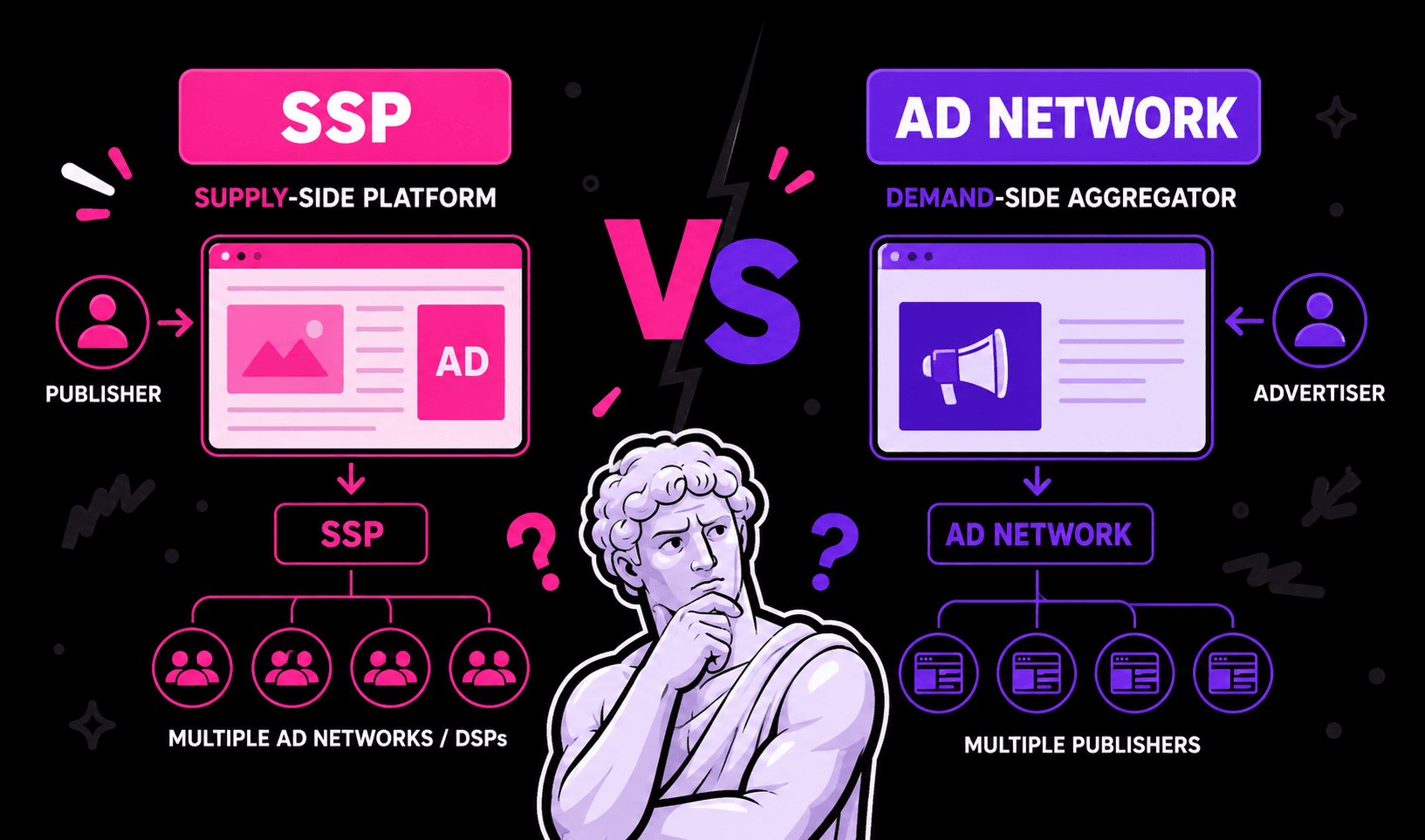
SSP vs Ad Network: What’s the Difference?
The ad network is an older model. The network buys space from publishers and resells it to advertisers. It has its own inventory and its own rates. The publisher joins the network and gets a fixed payment per impression.
An SSP works differently. It does not buy inventory – it only organizes auctions. The publisher remains the owner of the space, and the SSP simply finds the best price.
Parameter
SSP
Ad Network
Model
Real-time auction
Fixed rates
Many ad networks today use SSPs internally. But a pure ad network is a thing of the past. An SSP gives more money and more control.
Key Features of a Good SSP
Not all SSPs are equally useful. There is a basic set of features without which a platform cannot maximize revenue.
Yield optimization
Optimising revenue is the main task. The SSP must automatically select the best buyer for each impression to maximise the price. Algorithms learn from bid and impression history.
Floor prices
Floor prices – The publisher can set a minimum price per thousand impressions. The SSP will not sell below that price.
Header bidding
Header bidding – A technology that lets the SSP receive bids from multiple DSPs simultaneously, before the ad server makes a decision.
Reporting and analytics
The publisher must see who is buying their inventory, at what prices, and with what fill rate.
Top SSP Platforms for Publishers in 2026
The SSP market is large. Below is a list of platforms currently considered the best.
MyBid – A global ad network that also works as an SSP. Gives publishers access to demand from over 180+ countries.
Google Ad Manager – The giant with Ad Exchange, AdSense, and Google’s DSP. Suitable for large publishers.
Magnite – Formerly Rubicon Project. Strong in video and CTV advertising.
How to Choose the Right SSP (Checklist)
Choosing an SSP is an important decision. It determines how much your site will earn. Here’s what to look for.
Demand sources – More DSPs and ad exchanges mean higher competition.
Optimisation technology – Does it have header bidding?
Commission transparency – Some SSPs take a fixed percentage. Others have hidden fees not shown in reports. Look for platforms that honestly show what they take.
Format support – If you have video, you need an SSP with video monetisation. If mobile apps, look for an SSP with an SDK. No universal solution.
Minimum traffic – Many SSPs don’t accept small publishers. Google Ad Manager requires 5M impressions. MyBid, Sovrn work from 50–100k. Check before signing up.
Fraud protection and traffic quality – A good SSP checks for bots and gives tools to block unwanted advertisers (e.g., gambling if your site is about health).
Support – When something breaks (and it will), you need a human. Check if live support exists.
Reviews from other publishers – Search forums. Don’t trust marketing brochures. Find out how the platform behaves during downturns, whether it pays on time, and if there are hidden fees.
SSPs and the Programmatic Ecosystem
Programmatic is the automation of buying and selling advertising. The ecosystem consists of several types of platforms.
DSP (demand-side platform) – buys ads.
SSP (supply-side platform) – sells ads.
Ad exchange – the marketplace where DSPs and SSPs meet.
Ad server – the server that technically serves the ad.
When a user visits a website, the SSP launches an auction through an ad exchange. DSPs receive user data. The winning DSP delivers the creative via the publisher’s ad server. All in real time.
Without an SSP, a publisher cannot participate in programmatic auctions. They remain in the world of direct sales and ad networks, where revenue is noticeably lower.
Programmatic is growing. In 2025 it accounted for over 80% of digital advertising in the US, and similar in other countries. Publishers who ignore SSPs struggle.
FAQ
What is an SSP in simple words?
It’s software that helps website owners sell ad space for more money. It runs an auction among many buyers and gives the impression to the highest bidder.
What is the difference between SSP and DSP?
SSP works on the seller’s side (publisher), DSP on the buyer’s side (advertiser). The first wants to sell high, the second wants to buy low.
Does a small site with 5,000 uniques per month need an SSP?
Yes, but not all SSPs accept such traffic. You can start with ad networks that act as aggregators of small SSPs.
How does an SSP make money?
Usually by taking a percentage of each transaction. Typically 10–20% of the bid.
What is header bidding and why is it needed?
A technology that allows an SSP to receive bids from all DSPs simultaneously. Header bidding increases publisher revenue by 20–40%.
Can a site work with multiple SSPs at once?
Yes, and often does. Different SSPs have access to different DSPs.
How do you know an SSP is performing poorly?
If fill rate drops below 80–90% without changes to settings or if average CPM doesn’t rise.
Outro
An SSP is not a buzzword. It’s a tool that directly impacts publisher revenue. Without it, you are stuck with manual sales or outdated ad networks where the buyer dictates the price.
With a good SSP, you get access to dozens of DSPs, automated auctions, and header bidding. Your ad space starts being worth whatever the open market will pay.
MyBid works both as a DSP for advertisers and as a partner for publishers. Through the platform, you can sell inventory via connected SSPs or directly through auctions.
If you are a publisher and want to increase your ad revenue – sign up for MyBid. They will connect your sites, set up floors, and show you how much you can earn.