The MyBid blog is your expert guide to conversion traffic.
We share real-world case studies, insider tips, and practical guides for our
ad network. Learn how to master these tough verticals and run profitable
campaigns with our tools. No theory, just actionable advice to boost your profit.
[ Running Traffic on TIER2/TIER3 Without Bans: Pairing Proxies with an Ad Network ]
03.07.2026Affiliate Marketing How to start?12 min
Contents
Where competition is lower and traffic is cheaper, the demands on network infrastructure are higher. This guide breaks down the Astro and MyBid bundle: how to match proxies to a target GEO, how proxy-infrastructure economics work, and how to expand into new countries without bans.
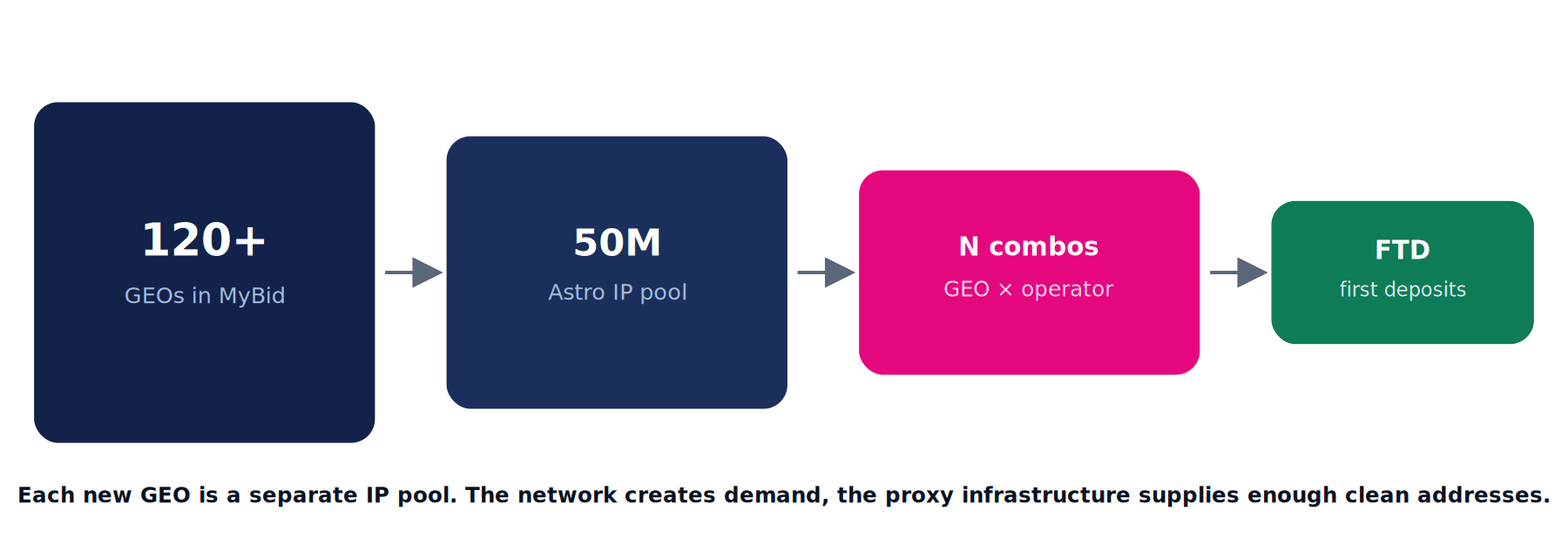
120+ countries in MyBid (TIER2/TIER3)
50 million IPs in 150 countries · Astro
99.9% uptime · HTTP(S), SOCKS5
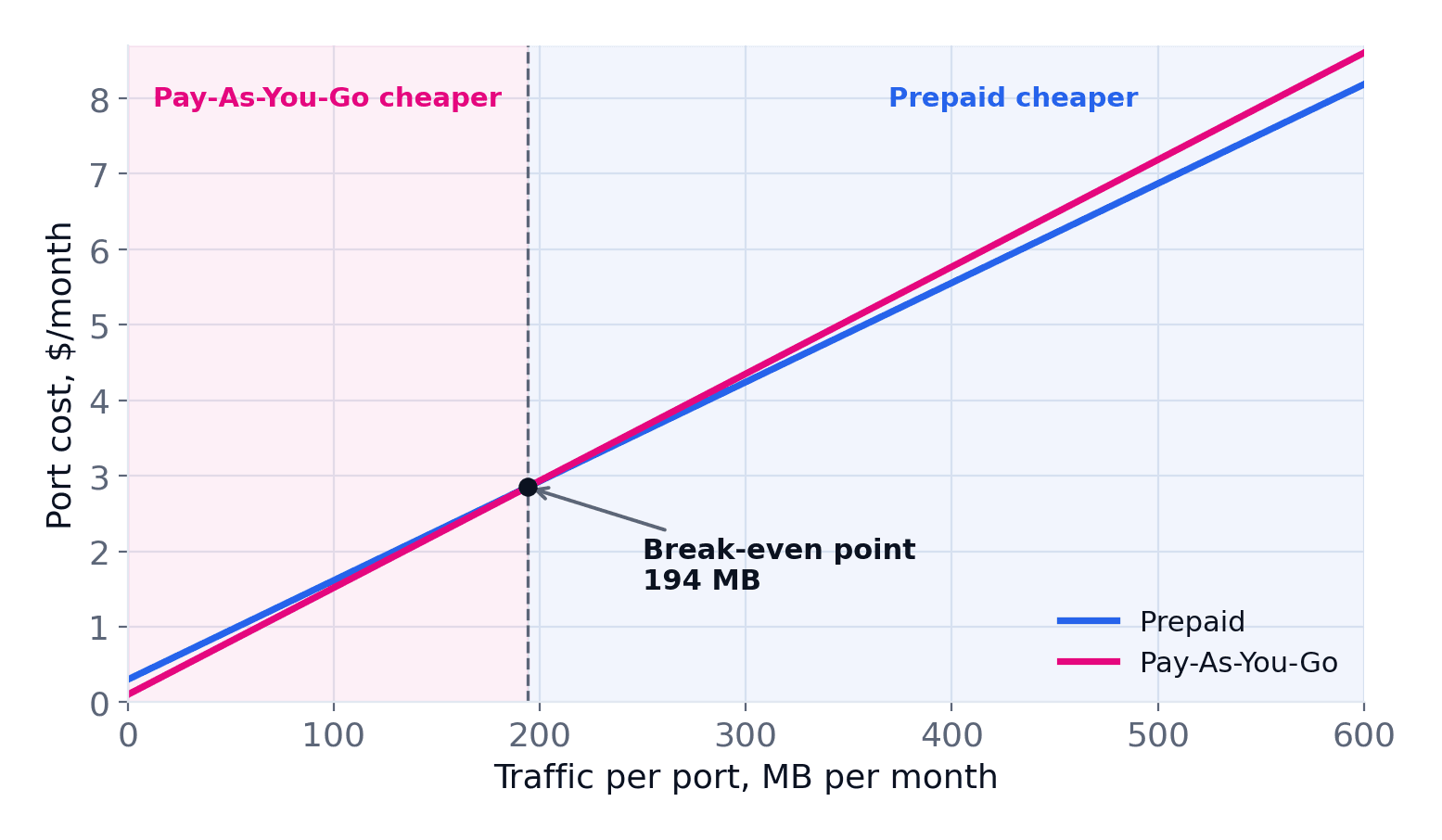
194 MB break-even threshold for mobile port.
TIER2 and TIER3: an underrated resource
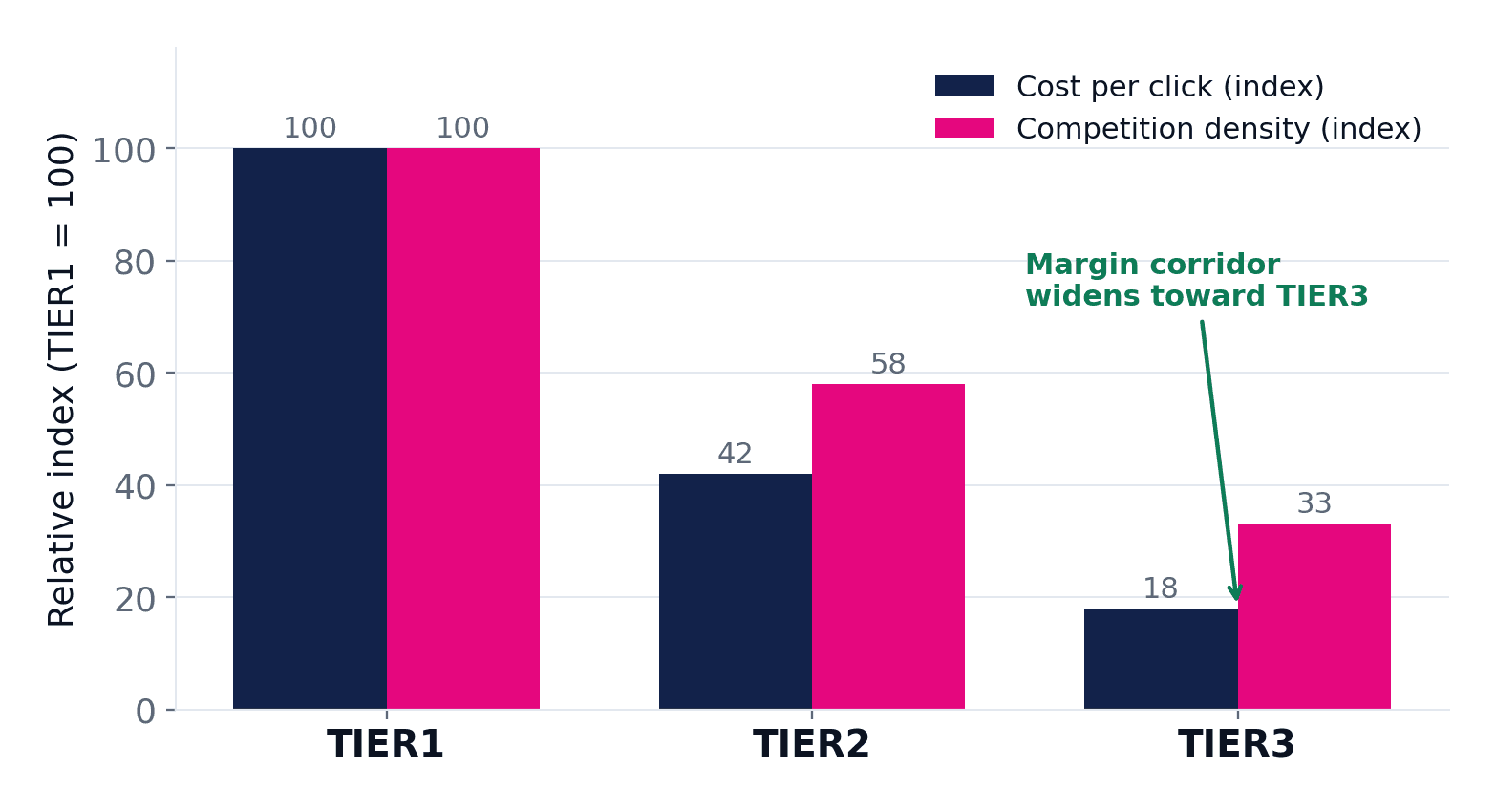
Premium GEOs are overheated. On TIER1, high cost per click and dense competition for the same inventory systematically erode margins. Teams working at volume increasingly shift budgets into TIER2 and TIER3 – Latin America, Southeast Asia, Africa, the CIS, the Middle East.
The economic logic is straightforward: lower competition for inventory means lower bids; cheaper clicks make test budgets last longer; less-saturated audiences burn out creatives more slowly. The potential profit margin widens as you move from TIER1 to TIER3.
Chart 1. Relative market benchmarks, TIER1 index = 100. Moving toward TIER3, cost per click and competition fall faster than conversion potential – which is why the margin corridor widens.
This resource comes with an access condition. Entering each new GEO requires a local, trusted IP from that exact country, and often a specific operator or provider. Without a consistent network environment, the ad platform and the offer will not recognize the traffic as local, and the campaign will be rejected before it even spends its test budget.
Where to run traffic: the MyBid ad network
Broad geography calls for a network that genuinely covers TIER2/TIER3, not just premium GEOs. MyBid monetizes 120+ countries, including TIER2, TIER3 and niche GEOs, so inventory is available for almost any GEO–offer combination.
• Performance-oriented formats. Push, Popunder, In-Page, plus Banner, Native and Video; for Telegram Mini Apps – Banner, In-Page and Video.
• Direct offers with zero KPIs. Campaigns launch at a comfortable pace, with no volume commitments from day one.
• No test period to start. Campaigns typically pass manual moderation within 20 minutes to several hours before going live.
• Built-in analytics by GEO. Traffic volume by country, available click volume, average and maximum bids – a reference for which GEOs are worth entering right now.
• Performance pricing models. CPM, SmartCPM, CPC, SmartCPC and CPA Goal with automatic optimization toward a target cost per action.
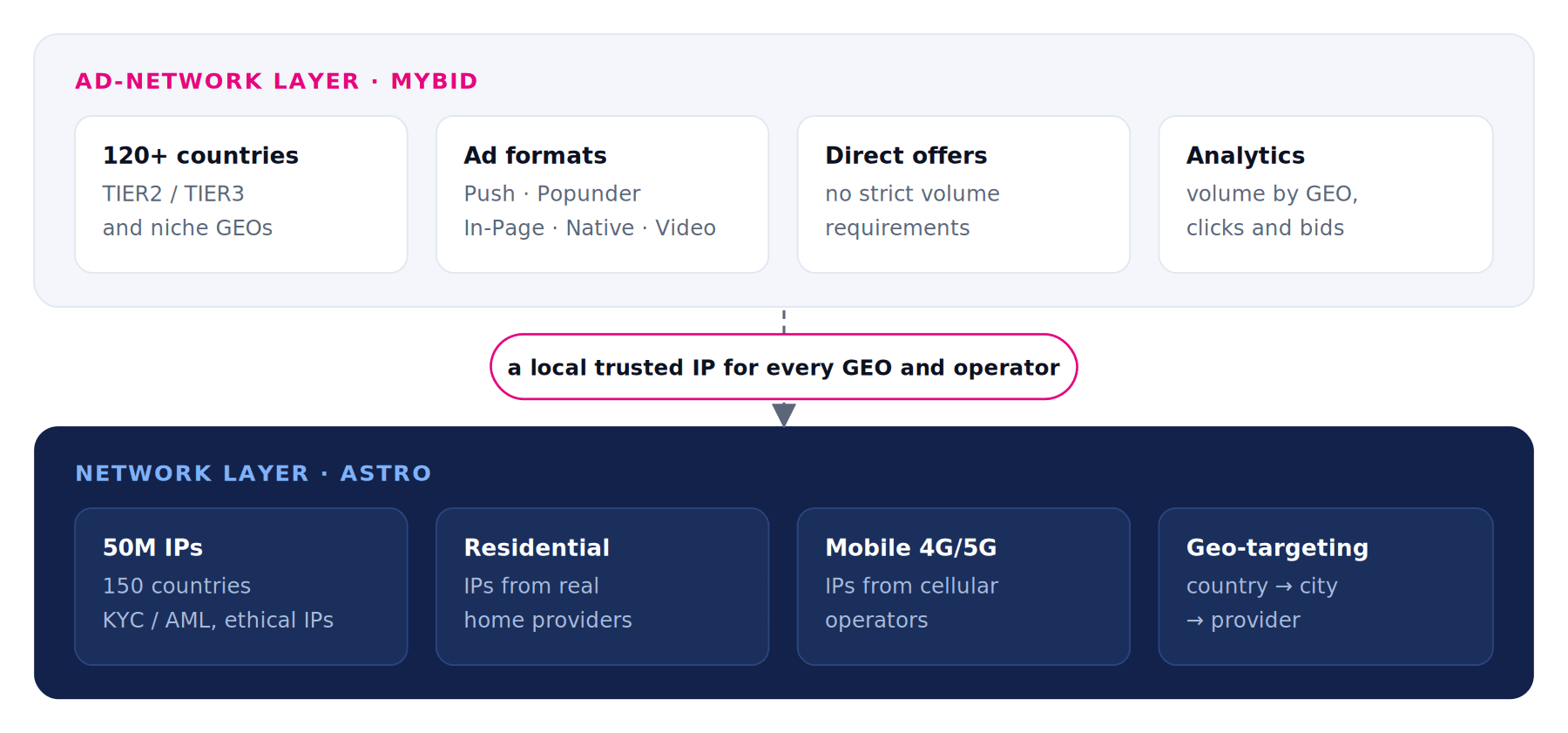
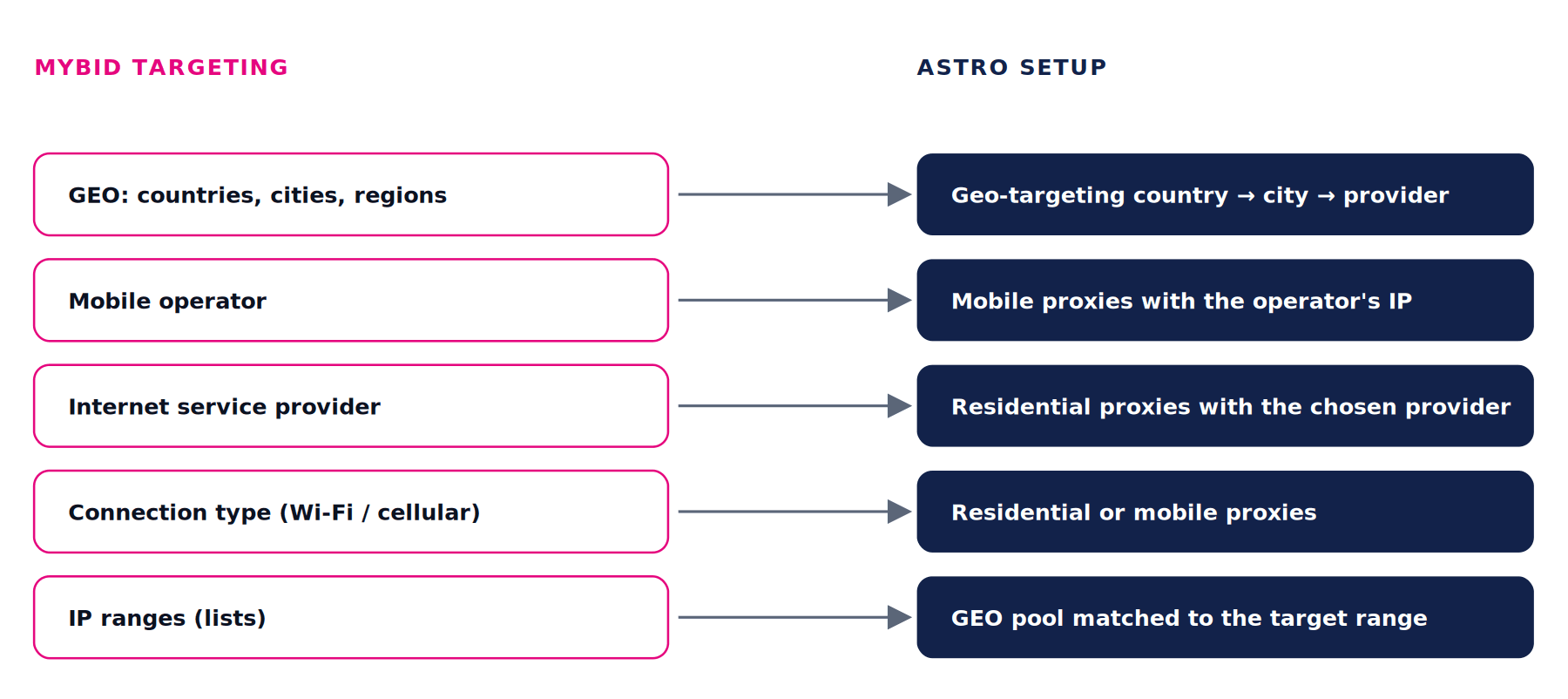
The key point: MyBid's targeting defines the requirements for your IP. The network targets by GEO (countries, cities, regions), mobile operator, internet service provider, connection type and IP ranges. Each of these is a requirement for the address through which you test creatives, check the SERP and work with offers.
Diagram 1. MyBid handles demand – where the traffic goes. Astro handles the supply of clean local IPs for every GEO and operator. The bundle is aligned at the network level.
What causes bans on exotic GEOs
Before setup, it helps to understand the nature of bans. The anti-fraud systems of ad platforms and of the offers themselves evaluate the network fingerprint on TIER2/TIER3 more strictly than is commonly assumed. A campaign is rejected on several typical signals:
• Geolocation mismatch. You are in one country, sending traffic to another and checking creatives from an unrelated IP – the first and most obvious signal.
• Questionable address origin. IPs with an unknown history and poor reputation are flagged by anti-fraud from the first request.
• IP overlap between entities. Dozens of ad accounts, trackers and analytics services on a single address read as one linked network.
• Unnatural connection dynamics. An abrupt address change within a single session looks anomalous to anti-bot systems.
This is solved not by a single action but by a properly built network environment – the responsibility of the proxy infrastructure.
Astro: the network layer of the bundle
Astro is 50 million IPs across 150 countries with 99.9% uptime. The pool is built from the addresses of real users in compliance with KYC and AML policies: these are ethical IPs sourced with user consent, not addresses with an opaque history. For TIER2/TIER3, this provides a local, trusted IP for practically any GEO the ad network monetizes.
150 countries with city and provider-specific settings
250 simultaneous connections per port
99.9% uptime · HTTP(S) and SOCKS5 protocols.
Geo-targeting matched to the network's targeting
Astro supports geography along the country → city → provider chain, with port grouping across several locations and the option to include or exclude up to 10 regions. This maps directly onto MyBid's targeting: the network lets you enter a specific city or reach a specific operator, and the infrastructure supplies an IP that matches that target.
Diagram 2. Each of the network's targeting parameters has a direct counterpart in the proxy setup. Consistency at this level is what separates a local user from suspicious traffic.
IP rotation modes
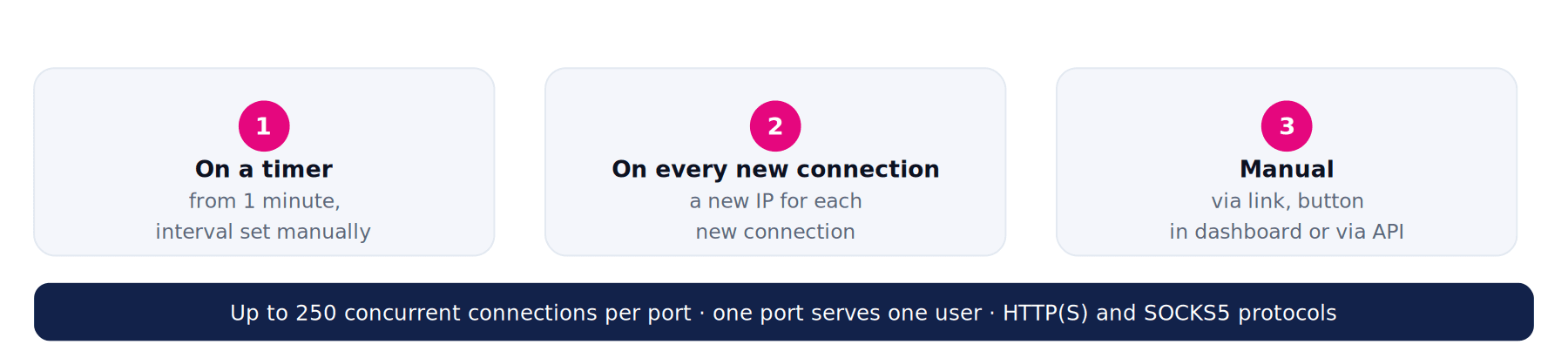
The external IP changes according to the selected mode, and different stages of work call for different modes – from a controlled address change to automatic rotation for bulk checks.
Diagram 3. One port holds up to 250 concurrent connections. Timer-based rotation is available from 1 minute.
Setting the interval in practice. With timer-based rotation (from 1 minute), set the interval so that it fully contains a single user visit with a margin: the user arrives, runs a session, completes it – and only then does the IP change. Changing the address too often within a single session is read by anti-fraud systems as an anomaly. When the moment of change is critical, manual rotation via link is more reliable: the IP changes strictly after the task is finished, and the same action is available via the API for automation.
Which proxy type for which GEO and task
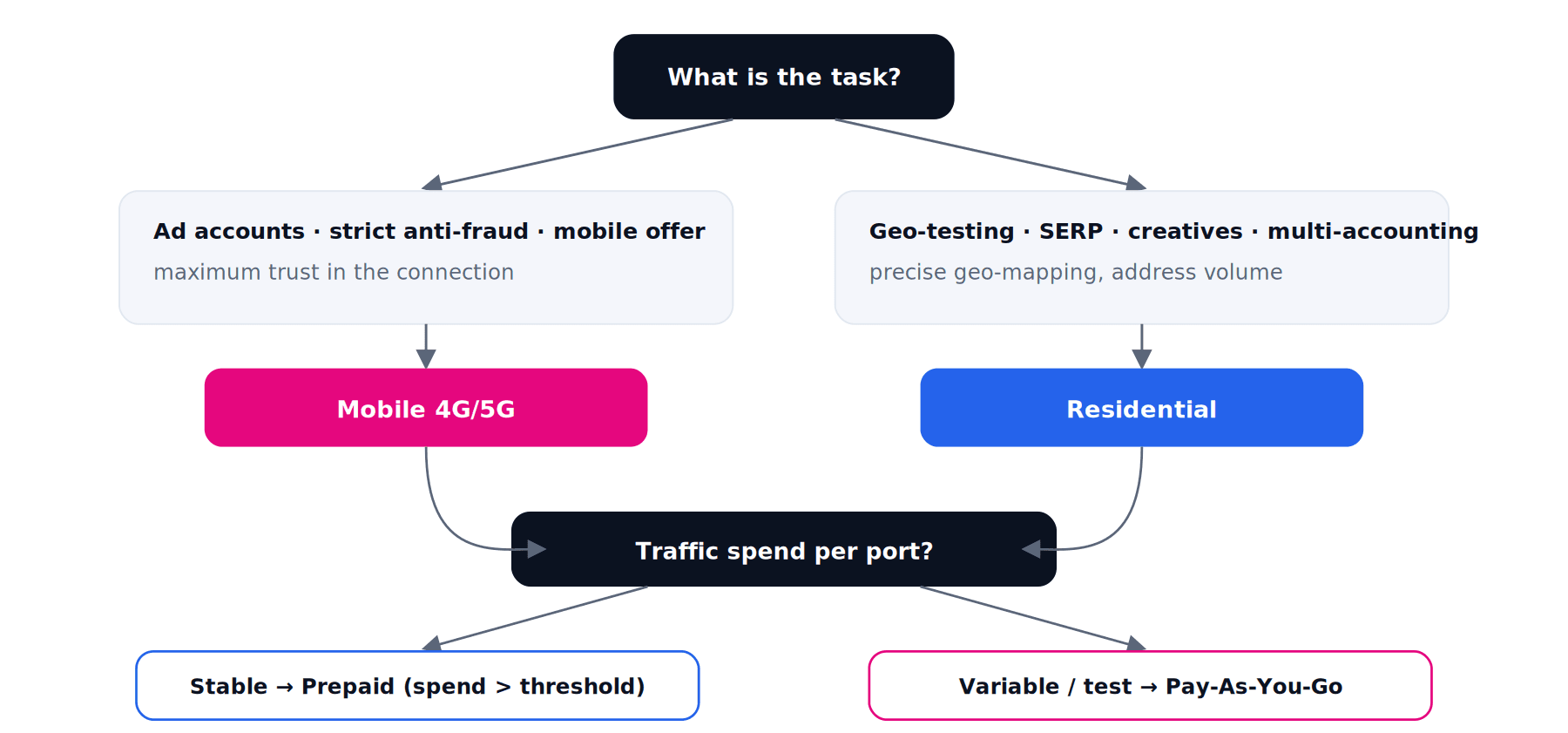
Two proxy types are used for media buying, each covering its own role. The choice is driven by the nature of the task and the strictness of anti-fraud in the target GEO.
Mobile proxies (4G/5G)
IPs from cellular operators – the connection type with the highest trust from platforms. The traffic looks like a real smartphone on a mobile network. If you target the “cellular” connection type or a specific operator in MyBid, your own traffic when working with the offer should run through a mobile IP from the same operator. This is the preferred option for strict anti-fraud environments and mobile-focused offers.
Residential proxies
IPs from real home providers. The core tool for geo-testing, checking the SERP and local ads, working with several accounts and multi-accounting. The right provider in the right country is selected for ISP targeting.
Diagram 4. The first branch is the proxy type by task. The second is the tariff model by per-port traffic spend; we turn to its economics in section 07.
The working cycle of entering a new GEO
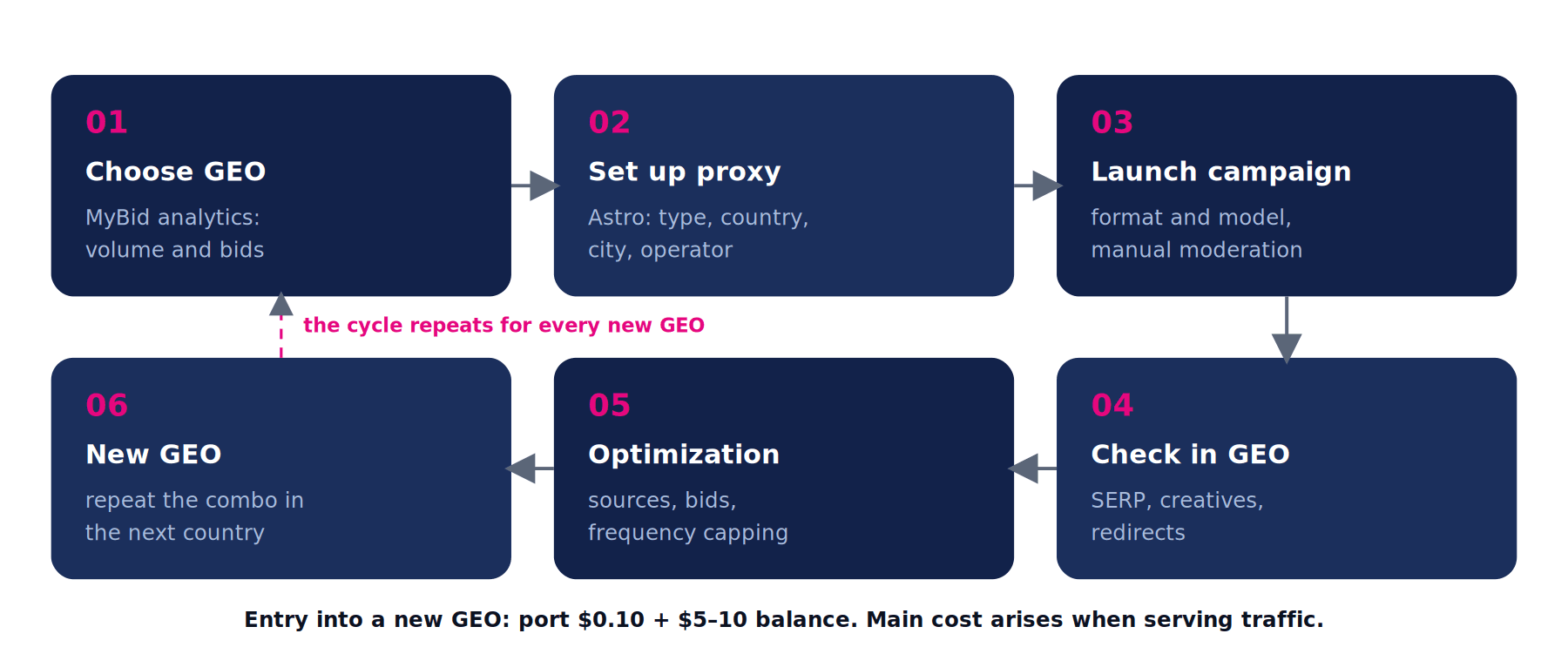
The bundle forms a repeatable cycle: each pass opens one new GEO.
1. Choose the GEO. In MyBid's built-in analytics you assess click volume and bids – for example, a mobile Push on a TIER3 country with high volume and low competition.
2. Set up the proxy for the GEO. In the Astro dashboard you add a port: network type, country, and where needed city and operator – matched to the campaign's targeting.
3. Launch the campaign. Format and pricing model by task (CPC for testing, CPA Goal for conversions), then send to moderation.
4. Local check. Through a proxy of the target GEO you verify that the offer, landing page and tracker render correctly, with no broken SERP or wrong redirects.
5. Optimize delivery. Manage sources, bids and frequency capping; cut inefficient traffic with automatic optimization rules.
6. Move to the next GEO. Once the combination delivers, the cycle repeats on a new country – and a new country requires a new pool of IPs.
Diagram 5. The cycle logic is linear: a new offer for a new country – proxies for the right GEO and operator – another clean combination.
Why “one GEO per campaign” is tied to proxies
MyBid's automatic optimization (CPA Goal) evaluates traffic at the segment level, defined as source_id + GEO + SSP_id, and for accurate algorithm performance it recommends one GEO per campaign with a steady stream of verified conversions via postback. This connects directly to the network layer: one campaign – one GEO – a separate pool of clean IPs for it. The more profitable GEO–offer combinations you launch, the more separate addresses you need so that each segment stays isolated and does not overlap with the others. The automatic optimization rules cut sources without conversions, while per-source bids buy additional volume on profitable sources – but that volume must still pass through trusted infrastructure.
Unit economics of the bundle
At volume, proxies turn from a secondary cost item into a substantial part of operating expenses. Managing this item comes down to one comparison: the average traffic spend per port against the break-even threshold by proxy type.
The billing unit is a port with built-in IP rotation. Two tariff models are available: Prepaid (traffic is purchased upfront, the remainder rolls over on top-up) and Pay-As-You-Go (paid as used, billed per 10 MB). The base tariff rates are below.
Parameter
Prepaid
Pay-As-You-Go
Port cost
$0.30
$0.10
Residential proxies
from $7.30 per GB
from $7.87 per GB
Mobile proxies
from $13.14 per GB
from $14.17 per GB
Traffic billing
upfront, balance rolls over
as used, per 10 MB
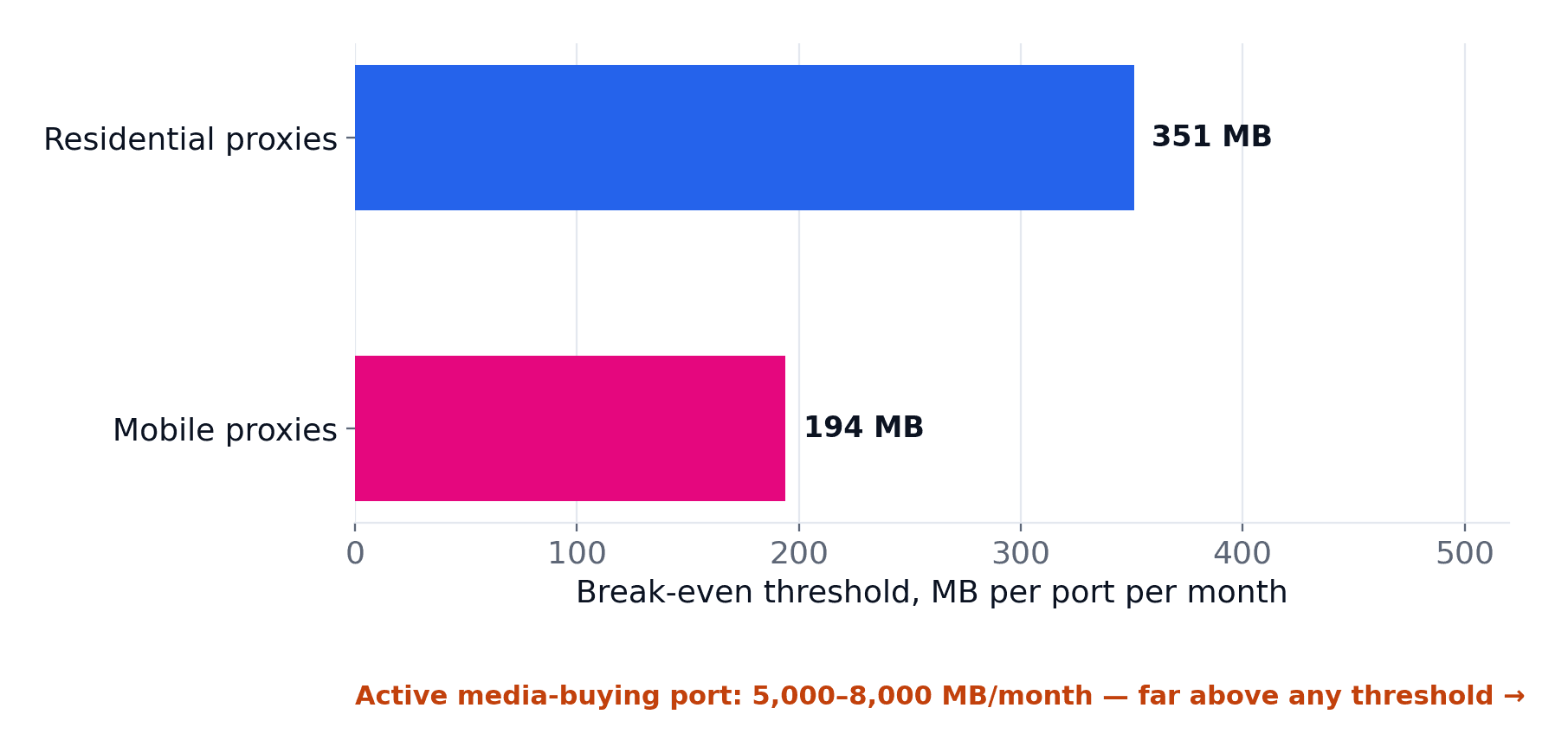
Pay-As-You-Go costs more per gigabyte but requires no upfront payment for traffic. The break-even threshold is the monthly per-port spend at which both models cost the same.
Chart 2. The break-even threshold is the monthly per-port spend at which both models are equal in cost. An active media-buying port spends far above any threshold, so Prepaid is the economical choice for steady volume.
Chart 3. The lines cross at 194 MB. Below the threshold, Pay-As-You-Go is cheaper (reserve, tests, irregular tasks); above it, Prepaid (active media-buying and warmed ports).
From this follows the principle of distributing ports between the two models.
Prepaid · steady, predictable spend
Pay-As-You-Go · variable, unpredictable spend
– Media-buying accounts in constant use
– Warmed accounts in active use
– Continuous monitoring with predictable volume
– Reserve ports
– Tests of new GEOs and combinations
– Irregular scraping and spy analytics
– Experimental configurations
The combined model in numbers
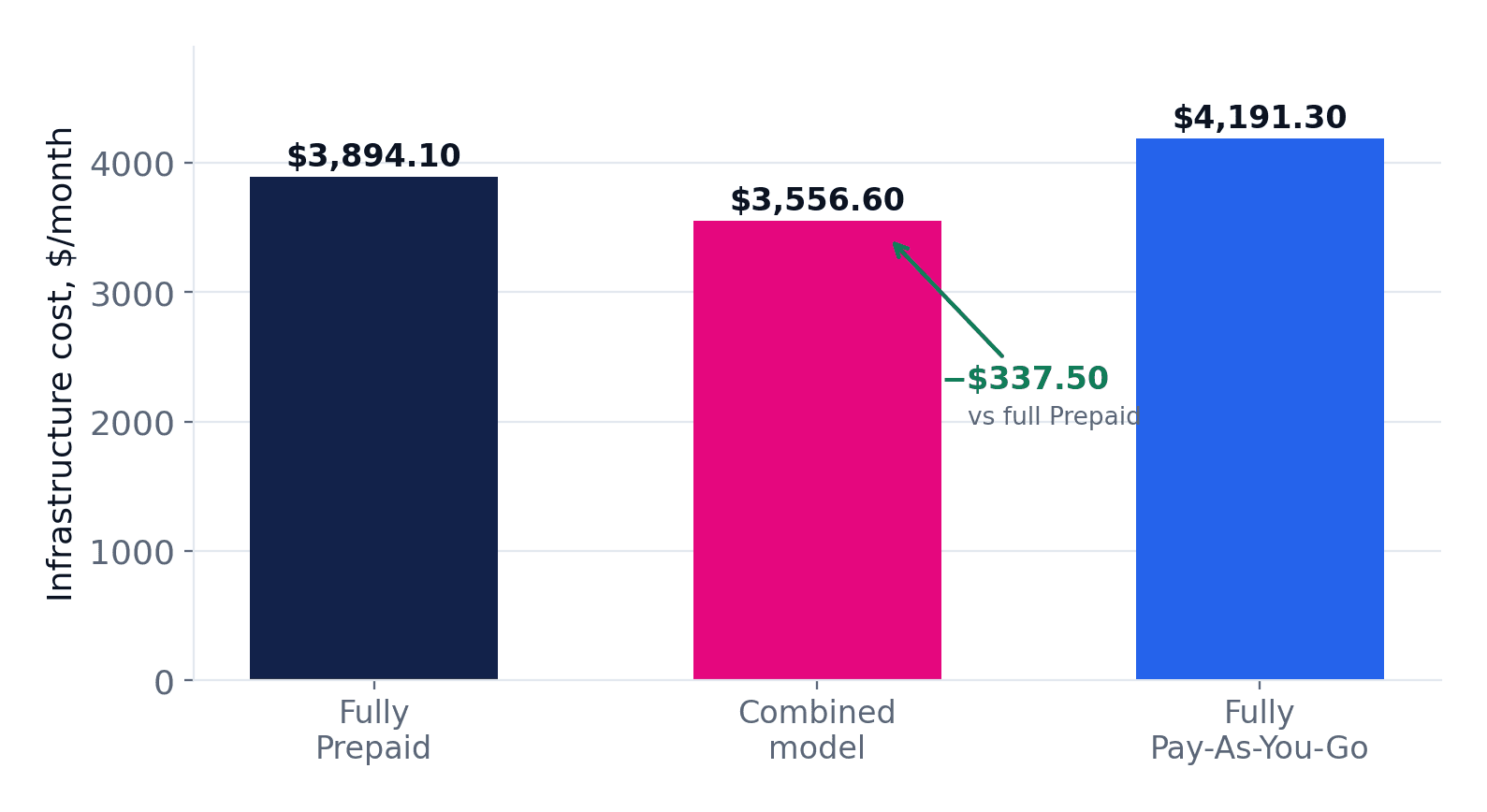
For a team of 30 accounts, a fully prepaid infrastructure costs $3,894.10 per month. If media-buying ports stay on Prepaid while irregular scraping moves to Pay-As-You-Go, in periods of low scraping spend (50 GB instead of the planned 100 GB) the total drops to $3,556.60. At full scraping volume the combined model is more expensive by only $56 – a controlled price for flexibility, not a systemic overspend.
Chart 5. Three tariff scenarios for a team of 30 accounts. The combined model wins in periods of low scraping spend and loses $56 at full volume – a manageable price for flexibility.
The reserve pool: fault tolerance almost for free
Reserve ports are needed to bypass routing issues, quickly move accounts on suspected IP compromise, and test new geolocations. Prepaying traffic for them makes no sense.
Pool of 10 reserve ports
Cost
Prepaid
$10.30 per month
Pay-As-You-Go
$1.00 one-time, no charges while idle
A nuance of Pay-As-You-Go: a port with no traffic for more than 45 days is moved to the archive. To avoid this, it is enough to send one test request through the port every 45 days – which is automated with a short cron script. On Prepaid the port rental lasts 30 days, and a port is restored from the archive within 14 days via the dashboard.
The effect of volume logic
The cumulative discount is based on the total amount of balance top-ups made within a 30-day period. The bulk discount applies to orders from 10 GB of total traffic and reaches 20%. An important detail: the bulk discount applies only to traffic-package purchases, so it is unavailable on Pay-As-You-Go. This is an additional argument for keeping predictable volume on Prepaid – it is what unlocks the maximum discount.
Team of 30 accounts
Cost per month
Base cost
$3,894.10
With 25% cumulative discount
$2,920.58 (−$973.53)
With 45% combined discount
$2,141.76 (−$1,752.35)
In annual terms, the combined optimization for such a team amounts to $11,000–21,000.
Entering a new GEO
When entering a new geolocation, traffic volume is unpredictable: actual spend can range from 1 to 50 GB, and a test can stop after the first day. Here Pay-As-You-Go works: a $0.10 port plus $5–10 on the balance, billed for the traffic actually used. If you stop the test, you pay only for what was used. This removes the risk of upfront losses during mass testing of combinations.
Growing the number of GEOs: a new IP pool for every country
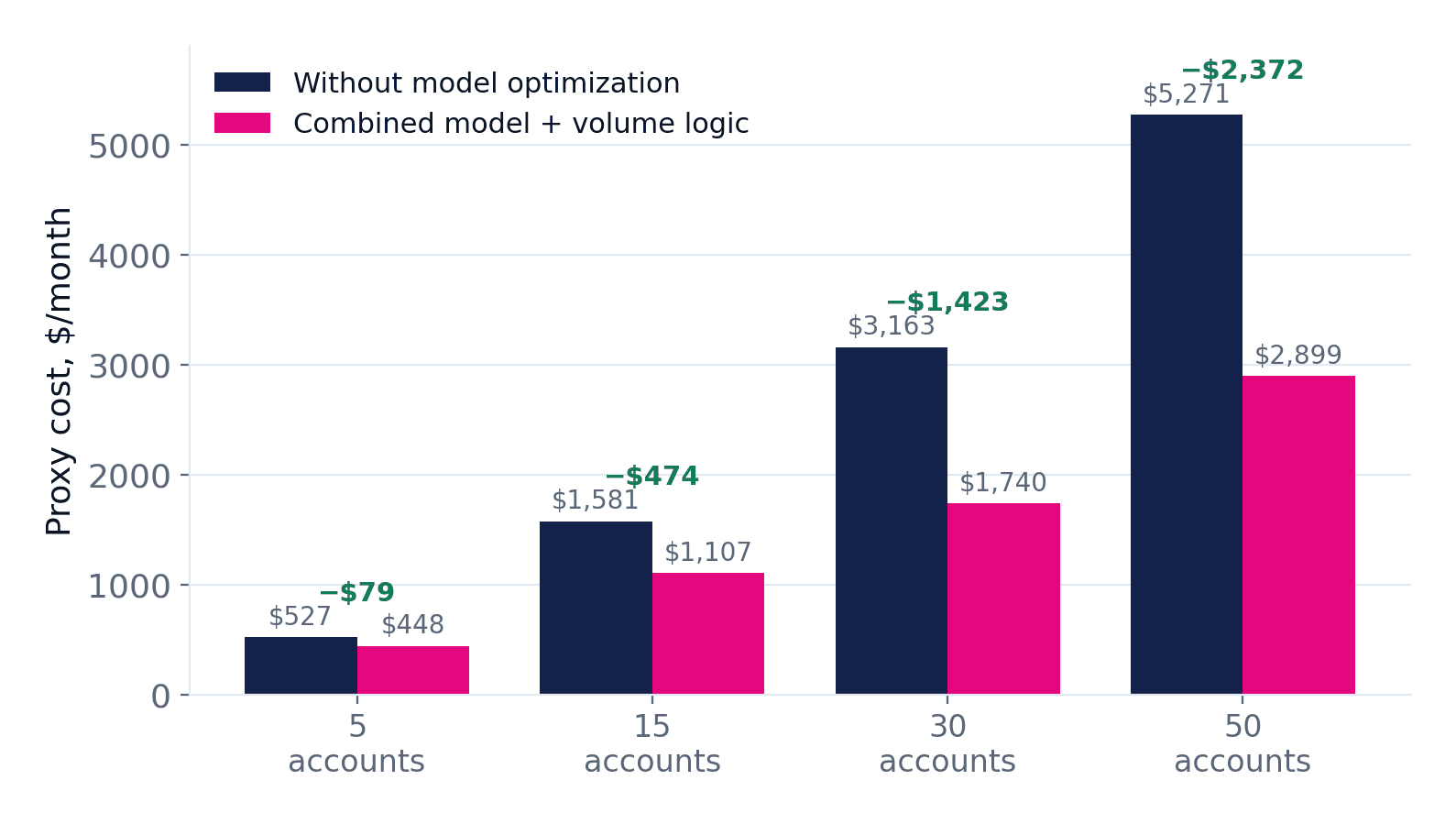
Working on TIER2/TIER3 is not one country but a constant expansion of geography. The more GEOs and accounts in play, the more separate IPs are needed to split accounts, processes and countries and reduce overlap between them. Here is the economics as the number of accounts grows.
Chart 4. Assumption: media-buying mobile ports only, average spend 8 GB per port; scraping and reserve from section 07 are excluded here – which is why the base is lower than the $3,894.10 full-infrastructure figure. The gap between the base and the optimized model widens as the number of accounts grows: for 30 media-buying ports, optimization yields about $1,400 per month, and up to $1,752.35 on the full infrastructure (see section 07).
Diagram 6. The network creates demand across 120+ GEOs; Astro's 50-million-IP infrastructure supplies enough addresses. Each GEO–operator combination represents a potential source of new first-time deposits (FTDs).
The growth logic is linear: a new offer for a new country opens a new clean combination, and Astro's infrastructure provides a separate pool of addresses for it. Proxies stop being a constraint on geographic expansion.
Astro × MyBid bundle checklist
• Choose the GEO in MyBid's built-in analytics by click volume and bids.
• Pick the proxy type: mobile 4G/5G for strict anti-fraud and mobile offers, residential for geo-testing and accounts.
• Spin up a port in Astro matched to the country, city and operator of the GEO targeting.
• Choose the rotation mode: manual via link for controlled change, timer-based from 1 minute for bulk checks.
• Split ports by tariff: steady volume – Prepaid, tests and reserve – Pay-As-You-Go.
• Check the SERP, creatives and redirects through a proxy of the target GEO before spending budget.
Build a test configuration for free
Before launching the infrastructure, spin up a test pool of several ports. Request a $3 balance credit from the Astro Support Team and check the GEOs, operators and connection stability you need on your own combinations, at no cost.